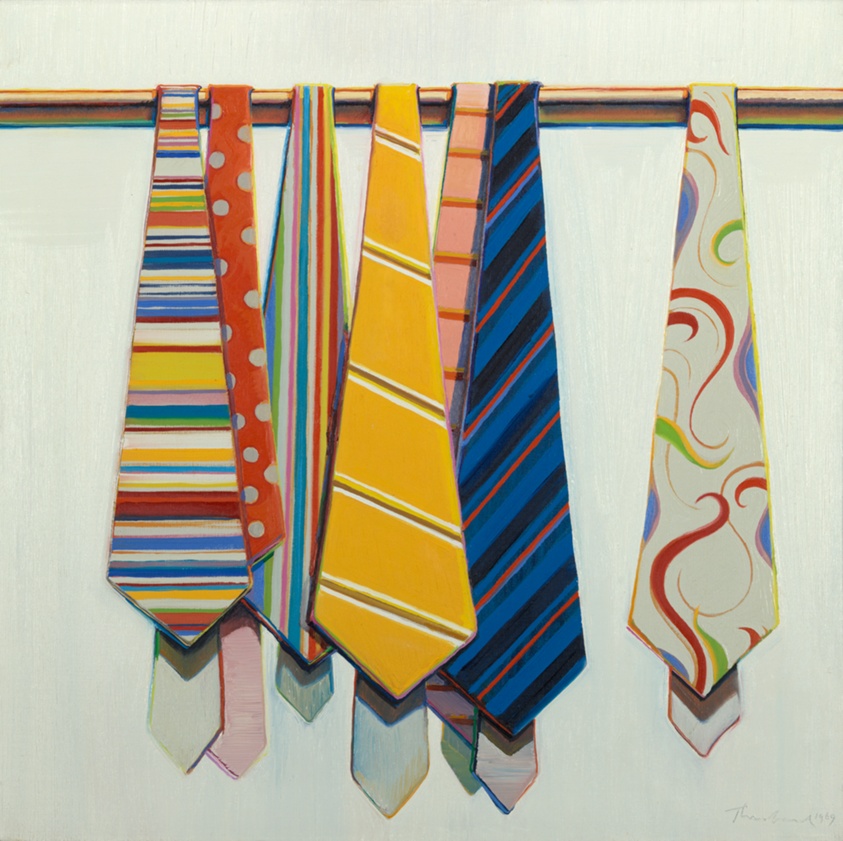
Wayne Thiebaud painted cakes, pies, sweets, shoes – and ties. In 1969 he devoted an entire group of works to them. Arranged side by side, his ties become rhythms of colour, pattern and almost geometric form while never ceasing to be real, recognisable objects.
One is striped.
Another is blue.
A third carries a small pattern.
Beside it is a red tie, then green, yellow and pink.
They all hang in almost the same way.
And no two are entirely alike.
In Wayne Thiebaud’s paintings of 1969, the tie rarely appears alone. It is seen in the company of other ties: on racks, in rows, one beside another.
The artist was clearly interested in more than the object.
He was interested in the sequence.
A year of ties
In 1969, Thiebaud produced an entire group of works centred on the necktie.
They included Tie Rack, Row Ties, Row of Ties, Tie Pile and Tie Tray. Surviving preparatory drawings further demonstrate that this was not a motif he encountered only in passing.
Tie Rack is particularly striking.
The painting is almost 183 centimetres high. Ties of different colours hang side by side from a three-tiered circular display.
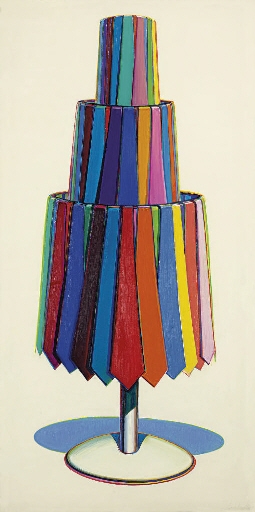
The rack itself almost resembles a tiered cake.
For Thiebaud, this is hardly an accidental association.
He was already celebrated for his paintings of cakes, pies, sweets and display counters. These too were frequently organised in sequences: the same basic form repeated while colour, decoration and position changed.
In 1969, ties took the place of cakes.
Order does not mean sameness
When objects are placed in a row, we first notice what they share.
With ties this is particularly clear.
They possess approximately the same elongated form.
They hang in the same direction.
They belong to the same category of object.
Then we begin to notice the differences.
One carries diagonal stripes.
Another small dots.
A third broad areas of colour.
Orange and green alternate on one; blue and white on another.
In Row Ties of 1969, individual ties can almost appear as small paintings contained within the larger painting. The fabric pattern becomes a miniature field for colour, line and rhythm.
Repetition does not make them identical.
On the contrary.
Only when they appear beside one another does it become clear how different one tie can be from the next.
Between object and geometry
Thiebaud never allows us to forget what we are looking at.
They are ties.
They hang from a rack.
They cast shadows.
They possess width and weight.
Some sit slightly askew.
Yet when enough of them occupy the same image, something else begins to happen.
We start to see triangles.
Verticals.
Stripes.
Repetition.
Rhythm.
White space between individual objects.
In Row Ties, the tie remains a real object while becoming almost a geometric sign.
Thiebaud works precisely at this boundary.
He does not turn the ties into pure abstraction.
He allows us to see the abstraction that was already present within the object.
The white background
Much of the effect of Thiebaud’s painting comes from the way he separates objects from their surroundings.
The ties are often placed against a light, nearly empty background.
There is no person wearing them.
No wardrobe.
No complete shop interior.
Object, rack, shadow and space remain.
This manner of presentation is partly connected with Thiebaud’s earlier experience as a commercial artist and illustrator. Before devoting himself fully to painting, he worked in advertising, where an isolated product against a clean background needed to attract the eye immediately.
In his paintings, however, the object is no longer selling anything.
The tie is offered to the gaze without asking us to buy it.
It retains something of the attraction of the shop display while losing its practical purpose.
Colour before interpretation
Thiebaud’s ties can be discussed as objects of everyday American life in the second half of the twentieth century.
They can be associated with business dress, commerce, consumption or the different identities clothing may offer.
But before any of these interpretations comes something more immediate.
Colour.
Deep reds, blues, oranges, greens, yellows and pinks appear in Tie Rack.
The tie is particularly well suited to such a palette.
It has long been one of the few elements of classic male dress permitted a freedom of colour and pattern much greater than that of the surrounding suit.
The dark jacket can remain the same.
The white shirt can remain the same.
Change the tie – and the emphasis changes.
Thiebaud’s rack displays that possibility in dozens of variations.
Ties and cakes
The connection with his famous paintings of confectionery is more than a biographical coincidence.
On the tie rack Thiebaud does something similar to what he does with cakes on a display counter.
He repeats the basic form.
Then changes the colour.
Repeats it again.
And again.
The object remains ordinary, but the arrangement creates a visual pleasure that no longer depends on its practical function.
We do not need to eat a cake to enjoy its colour and shape.
We do not need to knot a tie to look at its pattern.
The return of the bow tie
The tie did not remain merely an episode from 1969.
More than twenty years later, Thiebaud returned to a related motif.
In 1990 he produced his Bow Ties lithographs.
The National Gallery of Art in Washington holds two versions: one in colour and another in black and gray.
In the colour version, bow ties are arranged in rows.
Yellow.
Red.
Blue.
White.
Striped.
Dotted.
Plain.
In the black-and-gray version colour disappears, but the order remains. Silhouette, pattern and the relationships between forms become even more apparent.
The same object can thus be viewed once primarily through colour and again almost entirely through structure.
Difference within order
Nothing dramatic happens in Thiebaud’s tie paintings.
No one wears the ties.
No one knots them.
They belong to no particular portrait.
They simply hang.
One beside another.
Yet this arrangement reveals something we might not notice in a single tie.
The form repeats, while individuality remains.
There is order, but it does not produce uniformity.
Each tie shares its basic shape with the one beside it, yet retains its own colour, pattern and character.
Perhaps this is why a row in Thiebaud’s painting is never merely a row.
The more ties we see together, the more carefully we begin to look at each one.