On slight irregularity, proportion and the trace of the hand that give a well-tied necktie its character.
At first glance, a well-tied necktie seems to demand perfection: a regular triangle, equal sides and complete symmetry. Yet in elegance, precision is not always the same as beauty.
A tie knot is not a geometric form separated from the person wearing it. It is created by the movement of the hand, the responsiveness of the fabric, the width of the tie and the space between the collar points. Its quality is measured not only by regularity, but by the way all these elements work together.
Sometimes a slight irregularity is precisely what separates a tie that looks arranged from one that feels natural.
Order Without Rigidity
Symmetry gives a sense of order. A large, balanced knot such as the Windsor can therefore appear serious, formal and authoritative. Its form is immediately legible: a broad triangle placed firmly between the collar points.
Such a knot can be exceptionally harmonious when it suits the shirt, the material of the tie and the proportions of the person wearing it. Regularity alone, however, is not a guarantee of elegance.
When a knot is too large, too tightly drawn or too carefully shaped, it can lose its ease. Instead of belonging to the ensemble, it begins to attract attention to its own construction.
Good form needs order, but it should not appear rigid.
This is why slightly asymmetrical knots often feel more natural. Their irregularity is not the result of carelessness. It comes from the way the fabric passes through the knot and responds to movement.
Elegance then lies not in the perfect equality of two sides, but in a balance that remains alive.
The Beauty of the Four-in-Hand
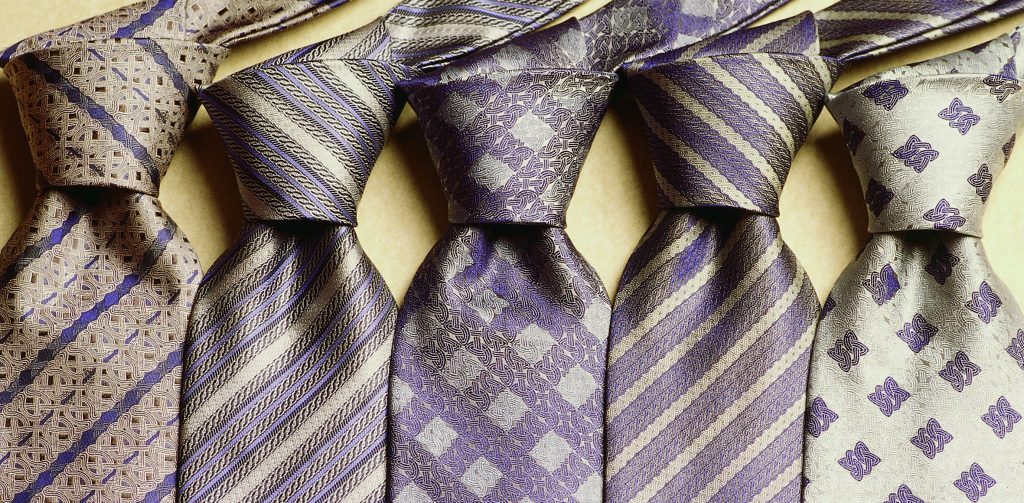
The four-in-hand never creates a perfectly regular triangle. One side is usually somewhat steeper, the other more relaxed. Its position may be slightly off-centre, while the final form depends on the silk, the interlining and the hand that ties it.
This natural asymmetry has become part of its lasting appeal.
It does not try to appear motionless. It does not conceal the fact that it was created through tying, pulling and adjustment. The movement that shaped it can still be sensed.
Such a knot may feel less ceremonial than the Windsor, but often more personal. It does not impose itself as the central event of the ensemble. It connects collar, shirt and tie in a calm vertical line.
Its simplicity is not an absence of thought. On the contrary, it requires a sense of measure.
A knot that is too small may disappear between widely spread collar points. One that is too large can lose its characteristic ease. A well-shaped four-in-hand lies between these extremes: present enough to complete the composition, yet discreet enough not to disturb its balance.
The Dimple as a Trace of Movement
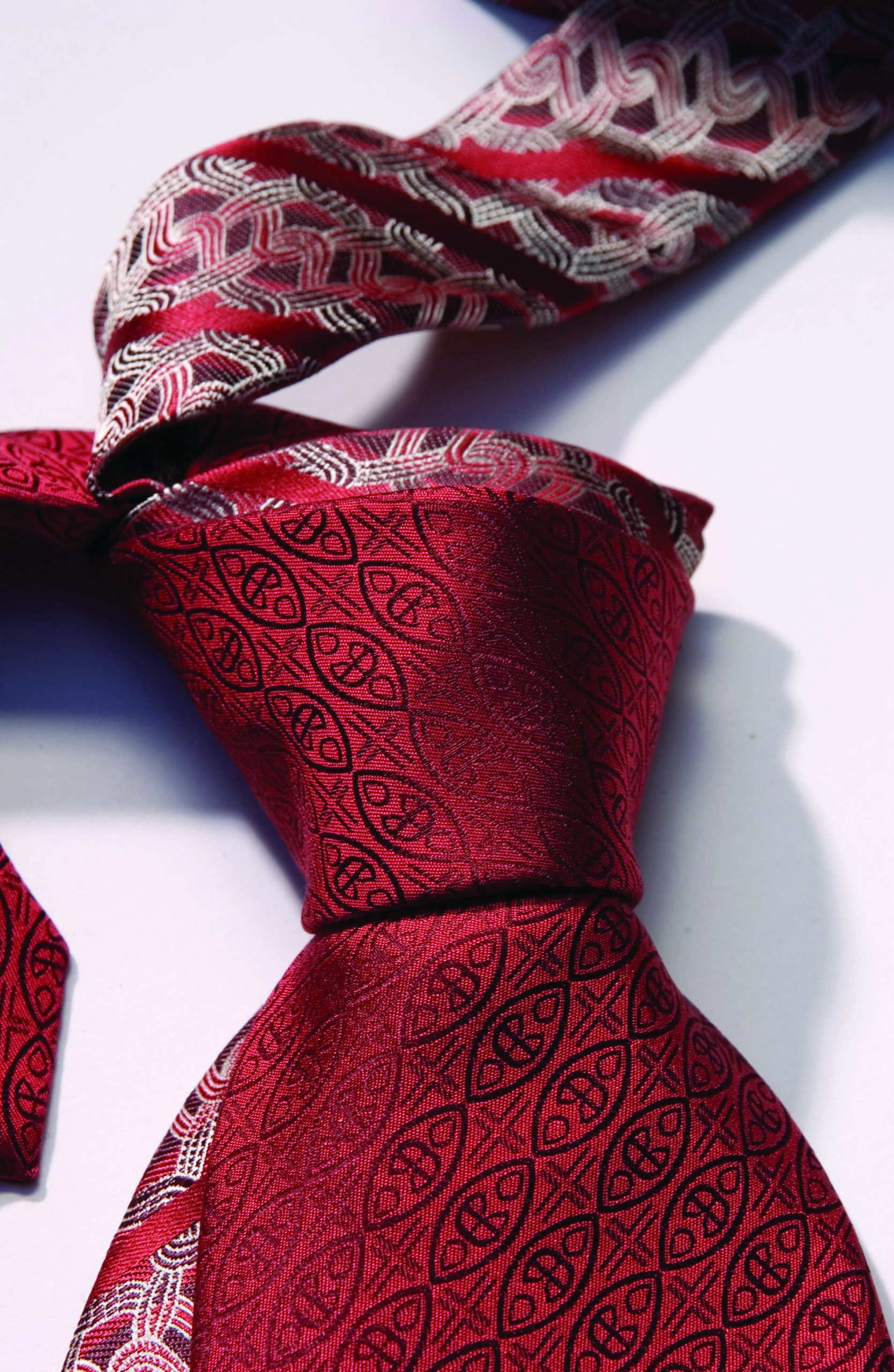
A small dimple often forms in the silk directly beneath the knot. It is sometimes described as the mark of a well-tied tie, but its value does not lie in serving as compulsory proof of technical skill.
The dimple gives depth to the surface of the tie.
Without it, the fabric may fall completely flat and appear two-dimensional. With it, the silk gains an interplay of light and shadow, and the transition between the knot and the body of the tie becomes more pronounced.
There is no universal rule here either.
The dimple may be centred and regular, or slightly displaced. It may be deep in softer silk or only suggested in a firmer construction. Its appearance depends on the weave, interlining, width and method of tying.
It is most beautiful when it does not look like a separately shaped ornament, but like the natural consequence of the movement by which the knot was tightened.
It is a small trace of the hand within an otherwise ordered form.
A Tie Is Never Alone
A knot cannot be judged without the collar that surrounds it.
A spread collar leaves more space and can accept a fuller, more symmetrical knot. A narrow collar connects more naturally with a smaller, elongated knot. The same is true of lapel width, the shape of the neck and face, and the volume of the tie itself.
No single knot can therefore be the best in every circumstance.
A large knot on a slender neck may feel too heavy. A small knot between widely spaced collar points can look unfinished. A richly interlined tie does not require the same number of wraps as a light, supple silk.
The aesthetic code of the tie is not a list of unchanging rules. It is an understanding of relationships.
The knot should belong to the tie. The tie should belong to the shirt. The shirt should be in harmony with the jacket and the person wearing them.
Only then can we speak of a whole.
When Too Much Effort Becomes Visible
In elegance there is a delicate boundary between attention and excessive control.
A well-tied knot shows that a person has paid attention to dress. An over-shaped knot can suggest that all attention was directed towards the knot itself.
The difference is not always large. It may lie in excessive tightening, an exaggerated dimple or an attempt to force the fabric into a form that does not suit it.
The tie then ceases to follow the nature of the material. It becomes a demonstration of technique.
True elegance rarely requires effort to be visible. The result should feel considered but not laborious; precise but not sterile.
A knot does not have to look as though it will never move. It is enough that it retains its shape and harmony while the person wearing it moves.
Imperfection Is Not Carelessness
To value slight asymmetry is not to excuse a badly tied necktie.
There is a clear difference between irregularity that comes from the nature of a knot and carelessness that leaves the tie twisted, too loose or poorly placed.
Good asymmetry remains balanced. The knot may be slightly displaced, but it does not look accidental. One side may be more pronounced, yet the whole still rests calmly between the collar points.
Such irregularity gives character precisely because it exists within order.
The same relationship appears in many areas of design. A hand-drawn stroke differs from mechanical regularity. Natural material retains small variations in texture. A face is not completely symmetrical, yet those differences are part of what makes it recognisable.
The tie belongs to the same world.
Its elegance is not the elegance of a perfect diagram. It is the elegance of an object shaped on a person.
The Knot as a Personal Signature
Over time, the way a tie is knotted can become an almost unconscious personal signature.
One person always chooses a small, elongated knot. Another prefers a broader, more balanced form. Some tighten the knot high and firm, while others leave it slightly softer.
These differences are not necessarily questions of right and wrong. They reveal a relationship with clothing.
The most convincing knot is often not the most technically complex, but the one that feels natural to the person wearing it. The hand knows it, the material suits it, and the proportions repeat themselves without lengthy study in the mirror.
At that point, the tie ceases to be merely a prescribed accessory. It becomes part of a personal language.
The Balance Between Order and Life
A perfect knot can be beautiful. Symmetry can bring calm, formality and clarity. Yet the beauty of a tie need not always rest on perfect regularity.
Sometimes it needs a small irregularity to retain movement. A slight asymmetry to gain character. A dimple to give the silk depth. A trace of the hand to show that the object has not merely been placed, but worn.
The most beautiful knot is not necessarily the one in which no fault can be found.
It is the one in which there is no visible struggle between fabric, technique and person.
Its form may be regular or asymmetrical, small or full. What makes it elegant is harmony with the whole — and the sense that everything is in its place, although nothing appears forced.
This is the aesthetic code of the tie: not perfection, but a balance between order and life.