In Francis Bacon’s portraits, a human face may lose its clarity, become distorted or almost disappear into darkness. Yet the white collar, dark suit and tie often remain strikingly recognisable. Within this contrast, clothing ceases to be a secondary detail of portraiture.
A man sits in a dark space.
His suit is dark. His collar white. His tie purple.
The face is much more difficult to describe.
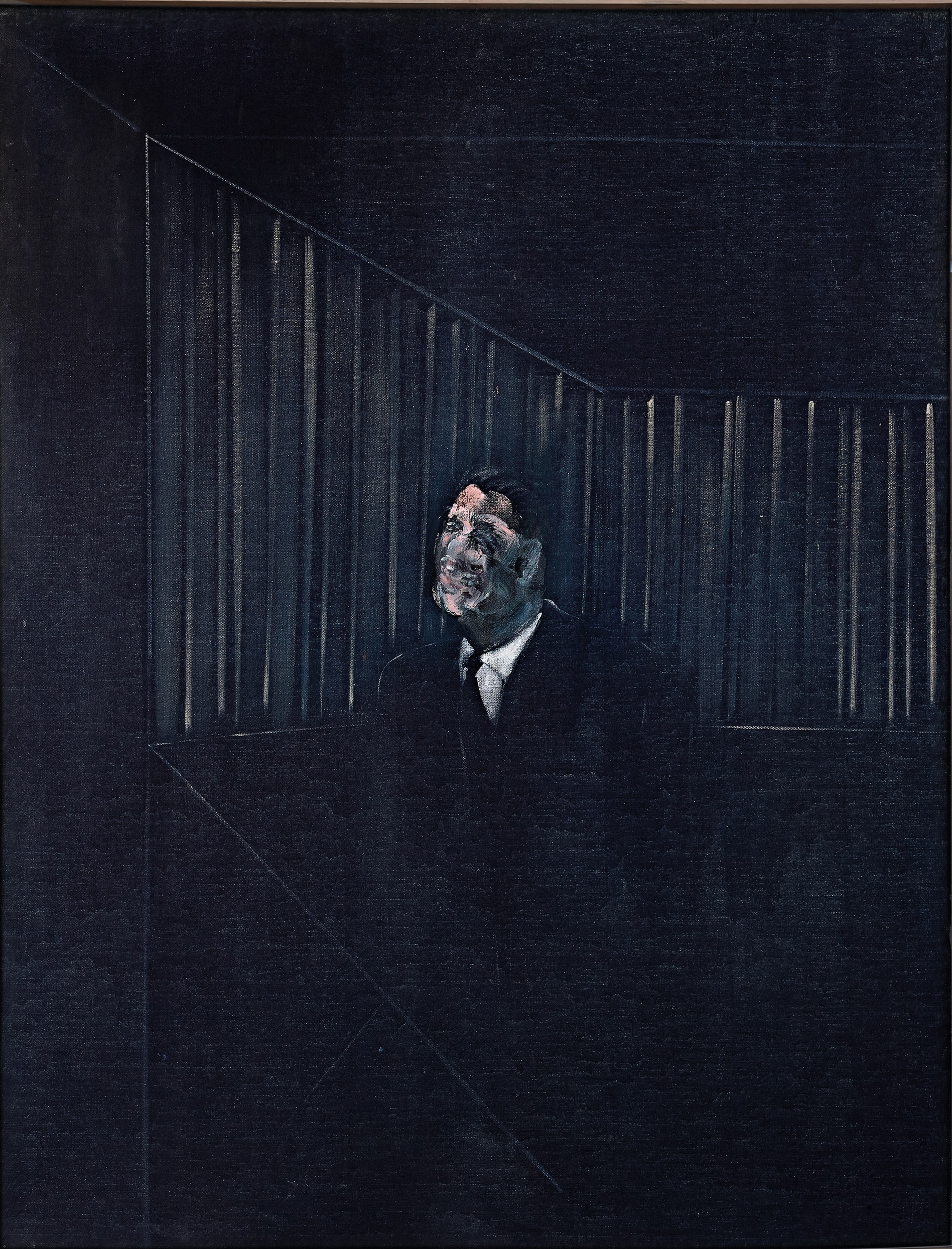
In Bacon’s Study for a Portrait of 1953, it appears and disappears within the dark movements of the painting. It cannot be read with the certainty of a traditional portrait. Yet a few centimetres below it, the image suddenly becomes clear again.
Collar.
Knot.
Tie.
Suit.
It is almost as if the clothing has retained the form that the face has lost.
A man recognised through his clothes
During the early 1950s, Francis Bacon repeatedly painted men in formal dress.
Some were anonymous. Some belonged to his circle. Others emerged as figures associated with the worlds of business or public authority. At the same time, Bacon was producing his famous variations on Velázquez’s portrait of Pope Innocent X.
The boundary between these worlds could be surprisingly narrow.
In a Study for a Portrait from 1952, Bacon replaced the ecclesiastical vestments of his papal figures with the formal suit and tie of a modern man. Art historians have associated this transformation with a movement from ecclesiastical authority towards the contemporary figure of high office – the politician or businessman.
The tie does not enter the painting as an isolated symbol requiring explanation.
It belongs to the way in which we recognise the figure.
We may not know who the man is.
But we know how he appears before the world.
The purple tie
The 1953 Study for a Portrait is particularly revealing.
A large male figure faces us in a dark suit, with a sharply white starched collar and a purple tie.
Around him is a dark, almost enclosed space.
Bacon destabilises the face, but he does not destabilise everything equally. The collar retains its sharp contrast against the darkness. The tie remains vertical and legible. The suit still establishes the silhouette of a seated man.
Even the choice of purple is intriguing.
Bacon scholar Martin Harrison has connected it to the papal paintings that immediately preceded this work. For years Bacon knew Velázquez’s Portrait of Pope Innocent X largely through black-and-white reproductions and mistakenly imagined part of the Pope’s clothing as purple.
In the new portrait, the Pope has disappeared.
But the purple remains.
Now as a tie.
A detail of contemporary dress thus almost imperceptibly connects two very different figures of authority.
Seven men in blue
A year later, Bacon continued to explore a related figure in his Man in Blue series.
Seven paintings – Man in Blue I-VII – were produced in 1954.
Again, a man appears in dark formal dress.
Again, he occupies a space that is not quite a room yet not entirely abstract. Vertical lines close around him like curtains, partitions or the bars of a cage. The face changes from painting to painting, at times more visible and at others almost submerged in darkness.
Below it, however, the familiar structure repeatedly returns:
white shirt,
collar,
dark suit,
tie.
Looking across the series reveals how little information is required to recognise a particular kind of human presence.
We do not need a name.
At times, we do not even need a clearly visible face.
Clothing is enough for us to recognise the public appearance of the man.
A portrait without certain identity
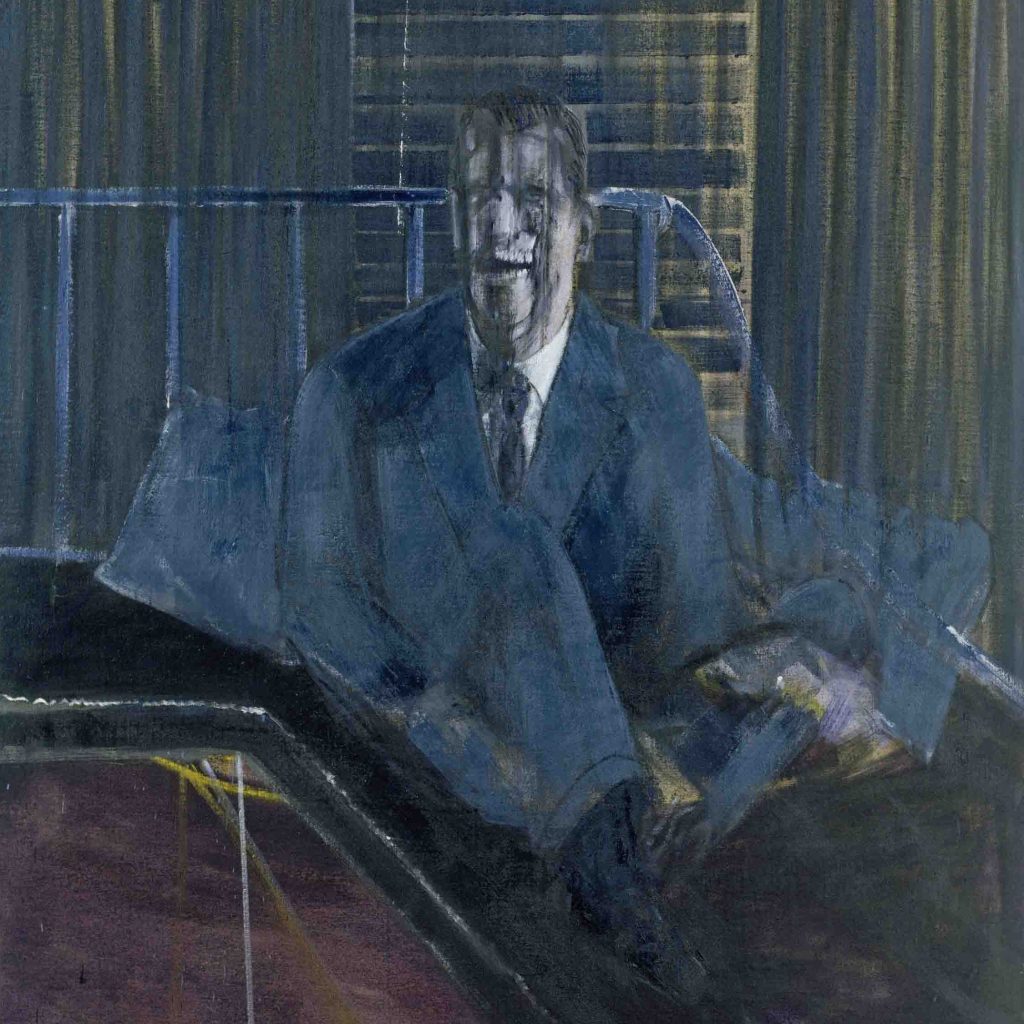
Francis Bacon [1909 – 1992]
Bildmass 152,2 x 118 cm
Inventar-Nr.: 5102
Person: Francis Bacon [1909 – 1992], Englischer Maler
Systematik:
Personen / Knstler / Bacon / Werke
Traditional portraiture generally attempts to preserve a person.
The face is its centre. It is expected to make recognition possible and to communicate something of the sitter’s character.
Bacon does almost the opposite.
His figures possess bodies, yet those bodies may be unstable. They possess faces, yet those faces may blur, shift or open into a scream. They inhabit spaces, yet those spaces often appear provisional and uncertain.
That is precisely why the details that remain legible acquire greater importance.
A white collar can become one of the sharpest lines in the entire painting.
A tie can remain one of its few stable verticals.
A suit may define the man before his face does.
This does not mean that the tie has one fixed meaning in Bacon’s work.
Something more interesting is happening.
It reveals how powerful clothing can be within the human image.
What remains
A tie is a small object.
On the body it occupies a narrow area between collar and torso.
Yet its form is remarkably persistent. A small knot and a few descending lines are enough for us to recognise it.
In Bacon’s work this simplicity encounters an entirely different pictorial language.
Everything around it may become uncertain.
The face may move.
The body may disappear into darkness.
The space may close in.
But the tie remains a tie.
Perhaps this is why it attracts more attention in these paintings than it might in an ordinary portrait.
Not because Bacon places it at the centre.
But because so much around it has ceased to be certain.
And as we attempt to recognise the man, we first recognise what he is wearing.