In the early 1960s, Jim Dine did not merely paint ties. He attached them to canvas, repeated them in drawings and prints, and described them as symbols returning from memory. In his work, the tie remains an object while also becoming a personal sign.
In 1961, Jim Dine made a work with the simple title Orange Tie.
Onto a small canvas he placed an orange surface and attached – a tie.
Not an image of one.
A real tie.
The boundary between an object and its representation suddenly becomes remarkably thin. Something that might have been painted now physically enters the artwork. The fabric possesses its own weight, folds and surface. The tie is no longer only a motif we look at. It is part of the material from which the work itself is made.
Throughout 1961 and 1962, Dine would return to the tie repeatedly.
Five real ties
Perhaps the most striking example is Five Silver Ties from 1962.
Five ties appear against a silver surface. Dine did not paint them illusionistically: they are actual neckties attached to canvas and covered with oil and aluminium paint.
The softness of the fabric remains visible in its folds, while the metallic surface gives the ties an almost solid, sculptural presence.
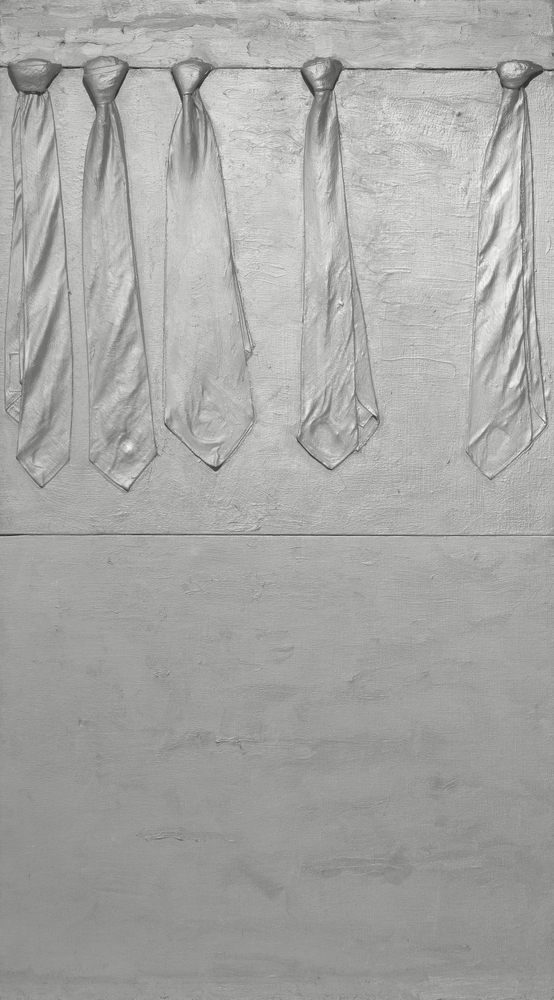
What stands before us is simultaneously painting and object.
The ties belong to the everyday world of dress, yet they can no longer perform the function for which they were made. Their knots are formed, the fabric is fixed, and their new environment is the surface of an artwork.
Dine does not conceal what the object is. Quite the opposite. The tie remains entirely recognisable.
Only the place in which we encounter it has changed.
The tie that returns
Why the tie?
An answer Dine gave in early 1962 may be more interesting than any later interpretation.
Speaking about ties in his work, he described them as “remembered symbols that are important because they keep coming back.”
He added an unusual detail: he had previously written poems in the shape of neckties.
For Dine, then, the tie was not merely a convenient example of an everyday object that could be transferred from life into art. It belonged to his personal visual vocabulary.
This matters because his early work was frequently considered in proximity to Pop Art, a world in which commodities, advertisements and familiar everyday objects entered the domain of art.
For Dine, however, the object was not necessarily anonymous. It could carry the trace of experience.
The Metropolitan Museum of Art identifies ties, bathrobes, painters’ palettes and tools among the objects through which Dine introduced an autobiographical presence into his work throughout his career.
A person does not have to be depicted in order to be present. Sometimes an object is enough.
One tie, many forms
The extent to which the motif occupied Dine in the early 1960s is already evident in the titles of his works:
Tie. Orange Tie. Flesh Tie. Halloween Tie. Informal Copper Tie. Little Black Tie in a Copper Space. The Universal Tie. Tie Parts.
The titles repeat the same object almost insistently. The works themselves, however, are anything but identical.
In Tie from 1961, now held by the Metropolitan Museum of Art, the necktie is made with wax crayon and graphite on cut papers.
In The Universal Tie, held by the Museum of Modern Art in New York, its elongated silhouette is produced in drypoint with watercolour additions.
In Orange Tie, an actual necktie is attached to canvas.
In the large Tie Parts of the same year, fragments of a tie are embedded in the painted surface.
And in The Composer’s Yellow Tie, now exhibited at the Museo Reina Sofía in Madrid, Dine combines acrylic on wood and canvas with actual silk and nubuck ties.
He did not discover a single way of representing a tie.
He explored how many different lives the same object could have within a work of art.
A useful object
One of the most charming examples appears in a 1961 portfolio with the unusually long title: These Are Ten Useful Objects Which No One Should Be Without When Traveling.
Ten useful objects that, according to the title, nobody should travel without.
One of them is a tie.
Dine presents it simply: broad, striped and brightly coloured. It appears almost as though it has been taken directly from a wardrobe or suitcase.
Here, humour is difficult to separate from seriousness.
A tie really is an everyday object. It can be packed, worn, tied and removed.
Yet this particular tie now belongs to a museum collection.
Something utterly ordinary has changed context without having to change its form.
Between picture and thing
Perhaps this is what makes Dine’s ties so distinctive.
He does not conceal them behind symbolism or deprive them of their recognisable form.
When he uses a real tie, it remains a tie.
When he draws one, its silhouette remains immediately legible.
When he repeats it, the object does not disappear into abstraction.
Yet every time it passes from wardrobe to paper or canvas, the way we look at it changes.
An object normally attached to the body now exists alone.
Something made to be worn becomes something to be observed.
And something so familiar that we almost cease to notice it acquires a new presence.
Jim Dine did not need to invent a new form.
A tie was enough.