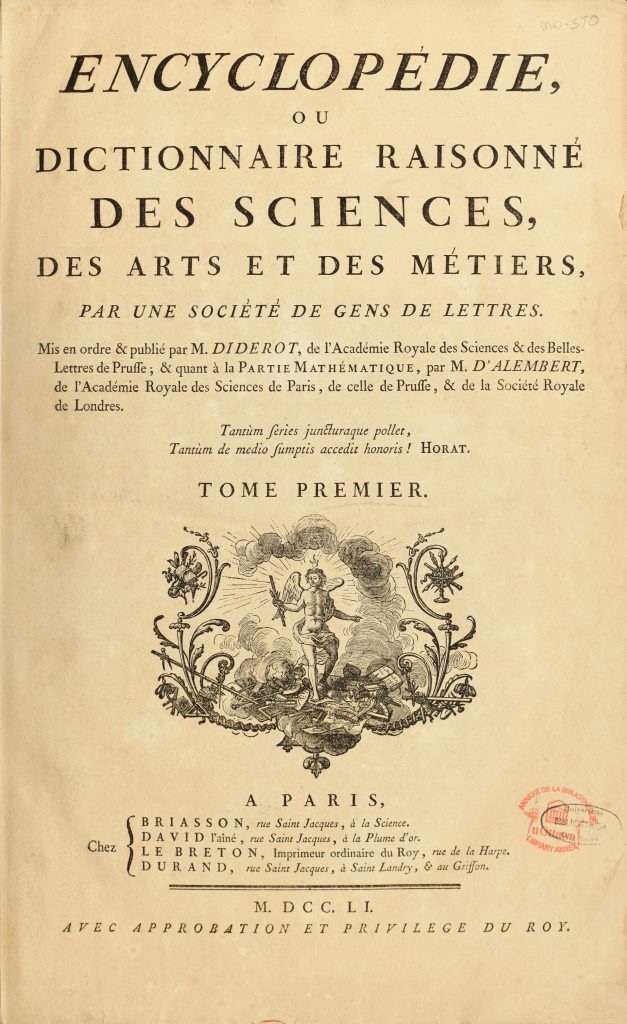
In the fourth volume of the renowned Encyclopédie, published in 1754 under the editorship of Denis Diderot and Jean le Rond d’Alembert, one finds the entries Cravate, Cravates, and Croate.
Within this Enlightenment lexicographical project, conceived as a systematic survey of contemporary knowledge, cravate is described as an article of dress – a fine piece of fabric worn and tied around the neck. In the same volume, cravates designates a cavalry unit in French service, associated with Croats. The entry Croate provides a concise geographical description of Croatia within the political framework of eighteenth-century Europe.
The encyclopedia does not develop a historical narrative; it records terms as they were understood at the time. The relationship between Croate and cravate appears as part of established linguistic usage.
Earlier French dictionaries of the seventeenth and early eighteenth centuries had already noted the same etymological connection. The inclusion of these terms in the Encyclopédie, however, carries particular weight due to the work’s intellectual standing. As one of the most influential reference projects of the Enlightenment, it reflects what had become part of accepted and standardized knowledge.
The 1754 entry thus represents a clear lexicographical trace in the history of the word “cravate.” It shows that a term shaped in a specific historical context in the seventeenth century was, by the mid-eighteenth century, firmly established in the French language and in European encyclopedic tradition.
Without emphasis or interpretation, the terms Croate and Cravate stand alongside one another – within the same linguistic and cultural sphere.