In his depictions of European battlefields from 1632 to 1648, Flemish painter Peeter Snayers repeatedly recorded Croatian horsemen. At Pressnitz, Einbeck and Dachau, a neckcloth is clearly visible among the distinctive elements of their appearance – a detail that scholarly literature connects with the origins of the cravat.
The history of the cravat is preserved in images as well as in words.
In the great battle compositions of the 17th century, details of dress are rarely the main subject. Precisely for that reason, however, they can preserve valuable traces of how individual military formations appeared and how they were recognised by contemporary Europe.
Among the most important visual testimonies of the period are the works of the Flemish painter Peeter Snayers, one of the leading masters of panoramic battle painting.
His compositions drew upon military reports, maps and graphic sources, while their foregrounds often contained officers, horsemen and soldiers presented in characteristic dress.
Among them were Croats.
Their presence in several of Snayers’ paintings is explicitly confirmed by scholarly catalogues and museum literature. Particularly important is the sequence extending from Lützen in 1632 to Dachau in 1648. Across almost the entire course of the Thirty Years’ War, Croatian horsemen appear as a recognisable group, and in several of these paintings a clearly visible cloth is worn around their necks.
Lützen, 1632
In Snayers’ depiction of the Battle of Lützen, Croats occupy the left side of the foreground.
A Croatian scholarly catalogue draws particular attention to a mounted officer wearing a red fur-trimmed dolman and carrying a mace as a sign of command.
In his analysis of Snayers’ cycle, Walter Kalina considers this prominent horseman to represent, in Snayers’ conception, Giovanni Lodovico Isolani, also known as Johann Ludwig von Isolani, commander of the Croats and of the Imperial light cavalry as a whole.
This distinction is important for understanding the painting itself. Snayers did not necessarily create portraits from direct observation of every individual represented. Kalina reads the horseman’s prominent position as an indication of the painter’s intention to include the commander of the Croatian troops within the composition.
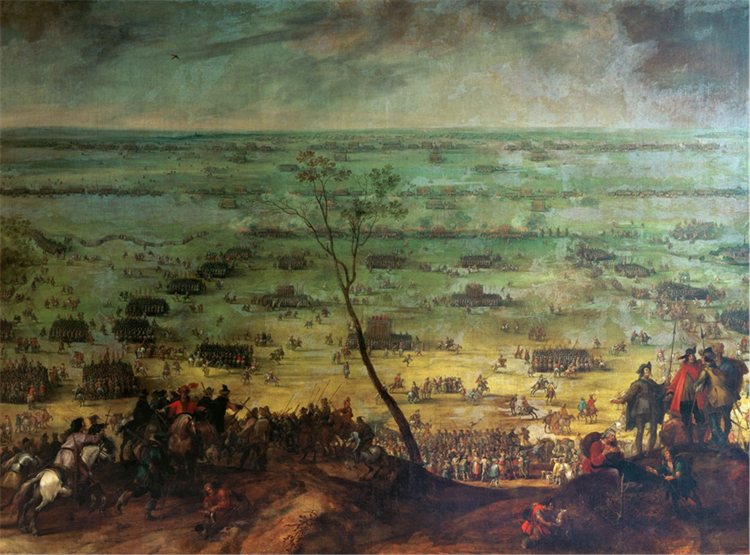
Peeter Snayers, Battle of Lützen. Event: 1632; painting: 1642. Reproduction: Wikimedia Commons, public domain.
Lützen is important as the beginning of the sequence. Croats appear early in Snayers’ pictorial world and are visually recognisable as a cavalry force with its own methods of warfare, equipment and appearance.
The Somme, 1636
Four years later, Croats appear again in Snayers’ depiction of the crossing of the River Somme.
The catalogue of the Ethnographic Museum in Zagreb places them in the lower right section of the composition and singles out a Croatian cavalry officer on a grey horse, carrying a distinctive weapon as a sign of his position.
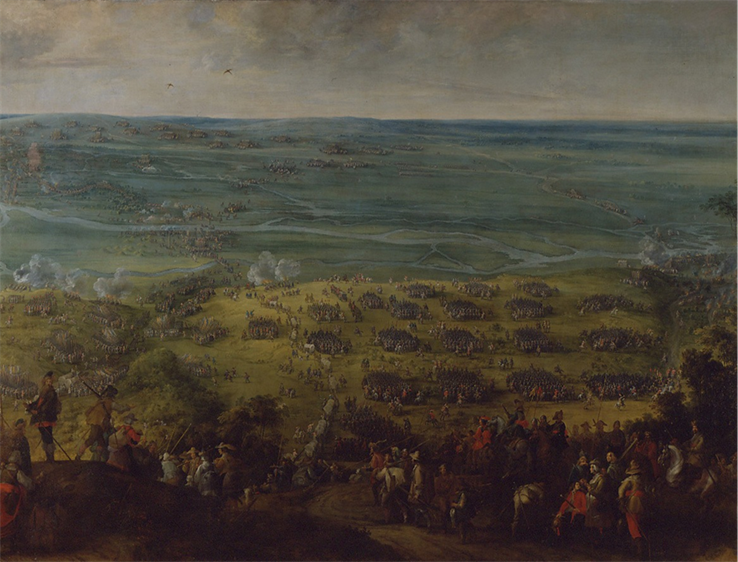
Peeter Snayers, Crossing of the Somme. Event: 1 August 1636; painting produced after 1636. Reproduction: Wikimedia Commons, public domain.
Together, Lützen and the Somme show that Snayers’ representation of Croatian horsemen was not an isolated motif.
They return on different battlefields and at different stages of the war, consistently presented as a distinct component of the Imperial cavalry.
Pressnitz, 1641
For the history of the cravat, Snayers’ depiction of the engagement at Pressnitz is particularly significant.
To the left of the Imperial commander Ottavio Piccolomini, the Croatian scholarly catalogue identifies three Croatian officers. One of them wears a clearly visible white cloth tied in a knot around his neck.
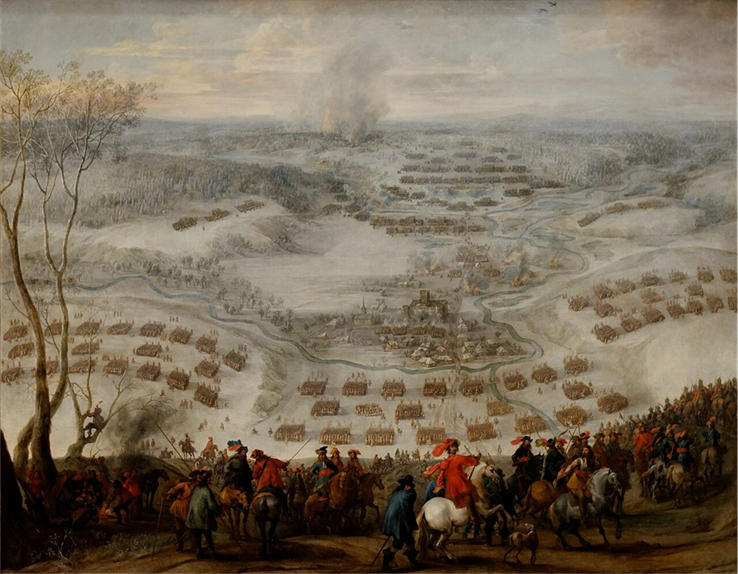
Peeter Snayers, Engagement at Pressnitz. Event: 27 March 1641; painting: 1648. Reproduction: Wikimedia Commons, public domain.
The catalogue raises the possibility that the cloth was silk and associates it with the officer’s higher status.
For the history of the cravat, however, the most important fact is the image itself: in the middle of the 17th century a Croatian officer is depicted with a piece of cloth wrapped and tied precisely around the neck.
This is not a later historical reconstruction. The neckcloth forms part of a painting produced close to the time of the event it represents.
Einbeck, 1641
In the same year, the neckcloth appears in another Snayers composition.
In the lower left section of The Siege of Einbeck, the Ethnographic Museum catalogue identifies a Croatian horseman wearing a black breastplate, a red sash and a white cloth around his neck.
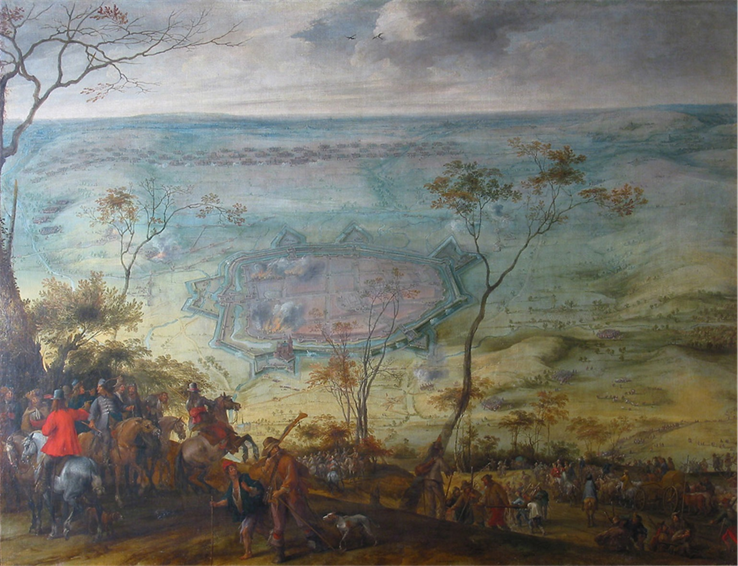
Peeter Snayers, Siege of Einbeck. Event: October 1641; painting: 1644. Reproduction: Wikimedia Commons, public domain.
The identification of the Croatian horseman is also confirmed by Austrian scholarship. In his analysis of the same painting, Walter Kalina explicitly refers to a Croat and draws attention to his characteristic dress.
Pressnitz and Einbeck therefore provide two closely related visual traces from 1641: Croatian horsemen wearing white neckcloths.
Dachau, 1648
At the very end of the Thirty Years’ War, Snayers once again depicted Croatian horsemen.
In Die Affäre bei München, representing the raid near Dachau on 5 October 1648, Imperial cavalrymen lead captured Swedish-French soldiers towards the foreground.
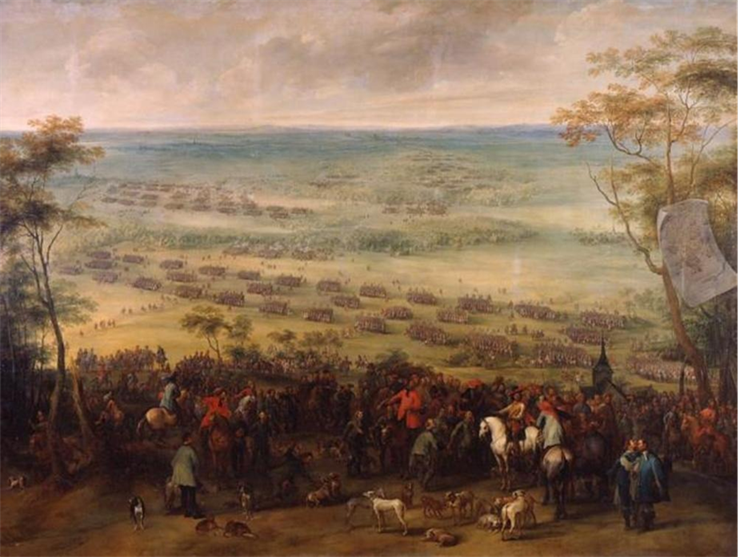
Peeter Snayers, Die Affäre bei München / Raid near Dachau. Event: 5 October 1648; painting produced after 1648. Reproduction: Wikimedia Commons, public domain.
Kalina explicitly identifies Croats among the horsemen and recognises several Croatian commanders in Piccolomini’s vicinity.
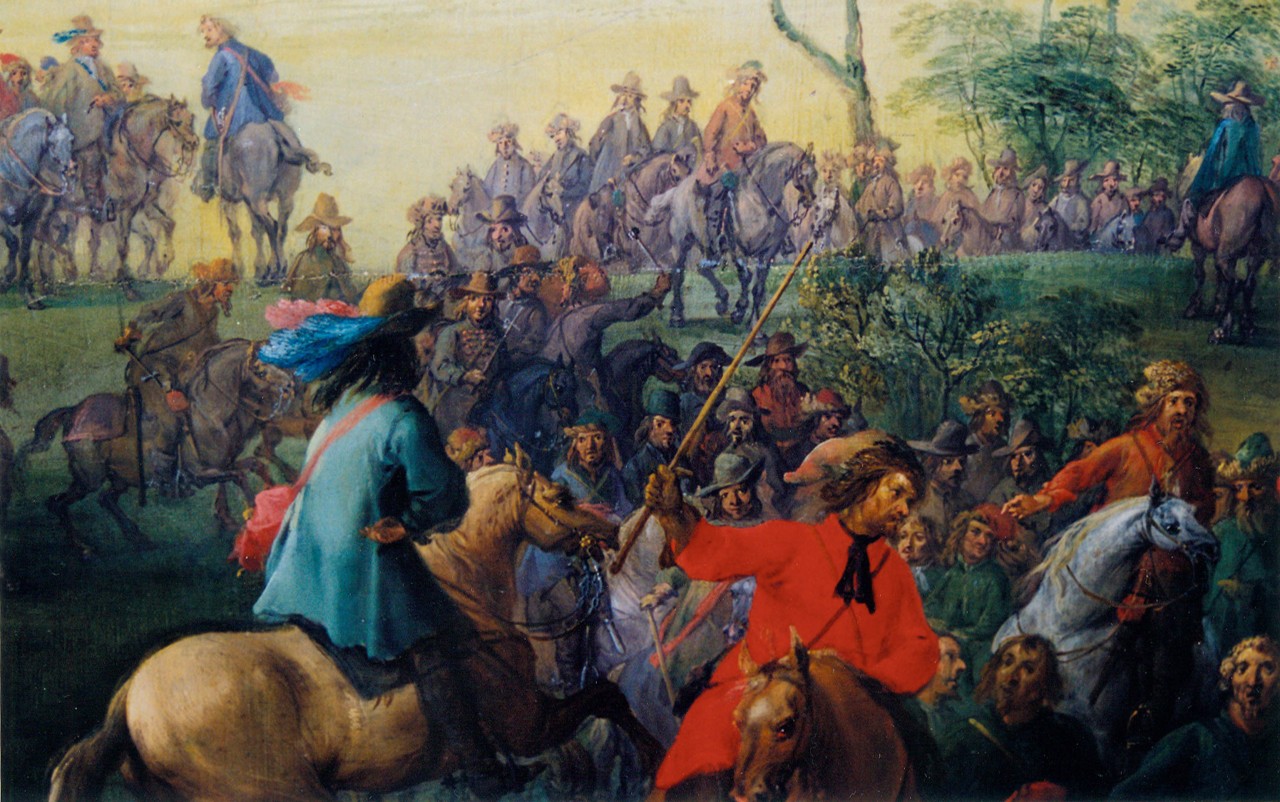
The Croatian scholarly catalogue goes further, drawing attention to two Croatian horsemen in red coats with black cloths around their necks.
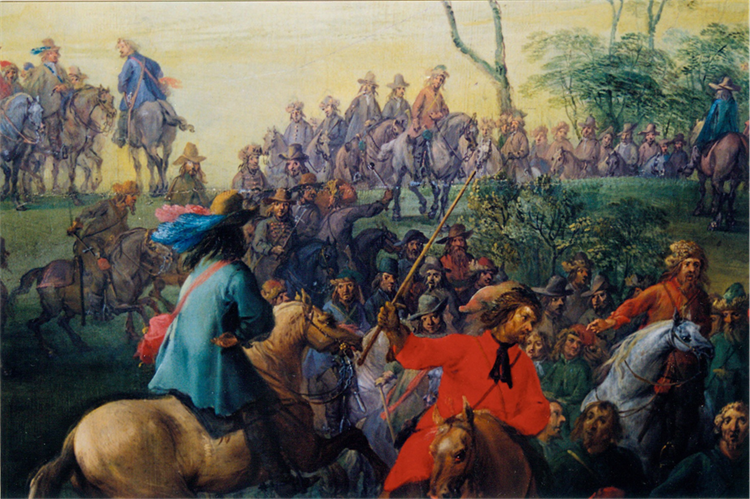
Detail of the same scene: a Croatian horseman in red with a dark neckcloth.
The white neckcloths depicted in 1641 and the black examples of 1648 do not point to a single prescribed form.
Their value lies elsewhere. At different locations, in different years and in different Snayers compositions, the same element of dress repeatedly appears: cloth worn around the neck of the Croatian horseman.
A Trace That Repeats
The value of Snayers’ cycle lies precisely in this continuity.
From Lützen in 1632, through the Somme in 1636 and the two images of 1641, to Dachau in 1648, Croatian horsemen appear across almost the entire course of the Thirty Years’ War.
At Pressnitz, Einbeck and Dachau, a neckcloth is clearly visible among the elements of their dress.
This visual evidence corresponds with written scholarship on Croatian military formations.
Historian Michael Weise, describing their characteristic dress, points to the neckcloth as one of the most enduring and influential attributes associated with the Croats. Beyond its practical purposes – protection from sweat and dust and its possible use in dressing wounds – this detail of dress would acquire a life far beyond the military world from which it emerged.
Visual and written traces therefore meet at the same place: around the neck of the Croatian horseman.
From the Battlefield to European Fashion
Snayers’ paintings were created during the very decades in which the Croatian name was becoming increasingly familiar within the military world of Western Europe.
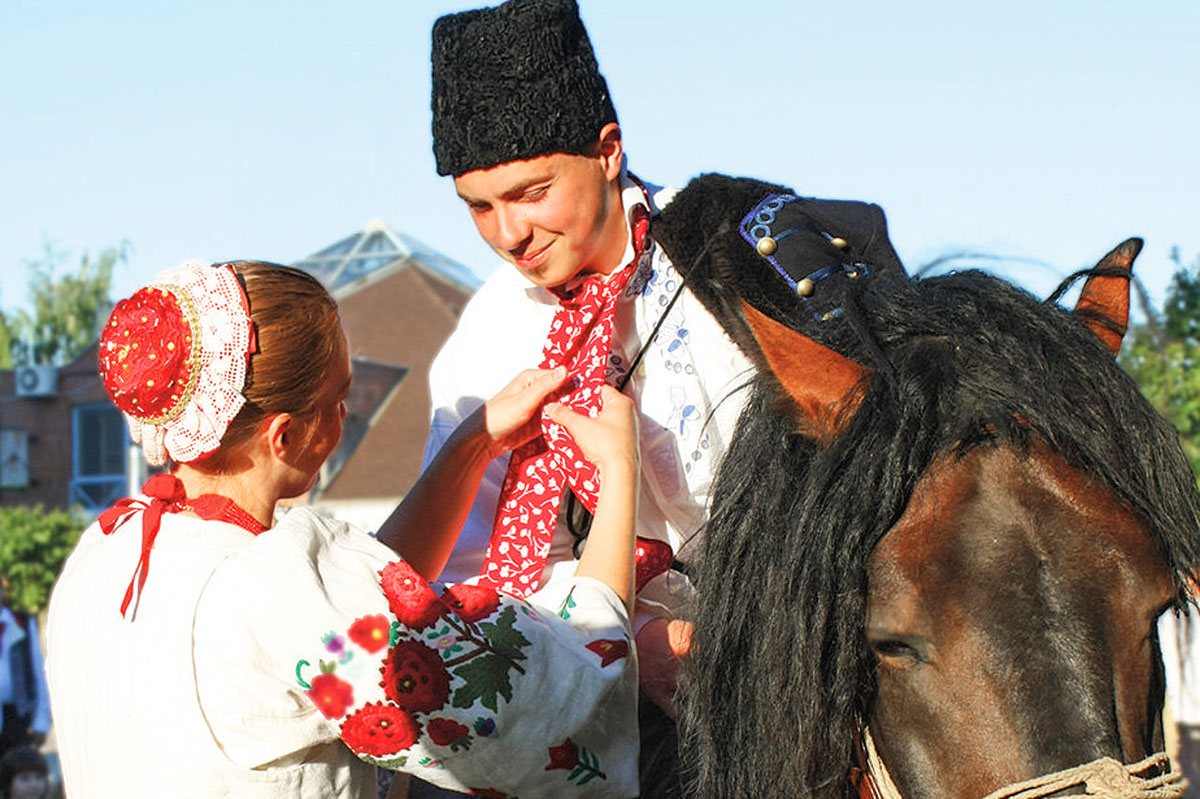
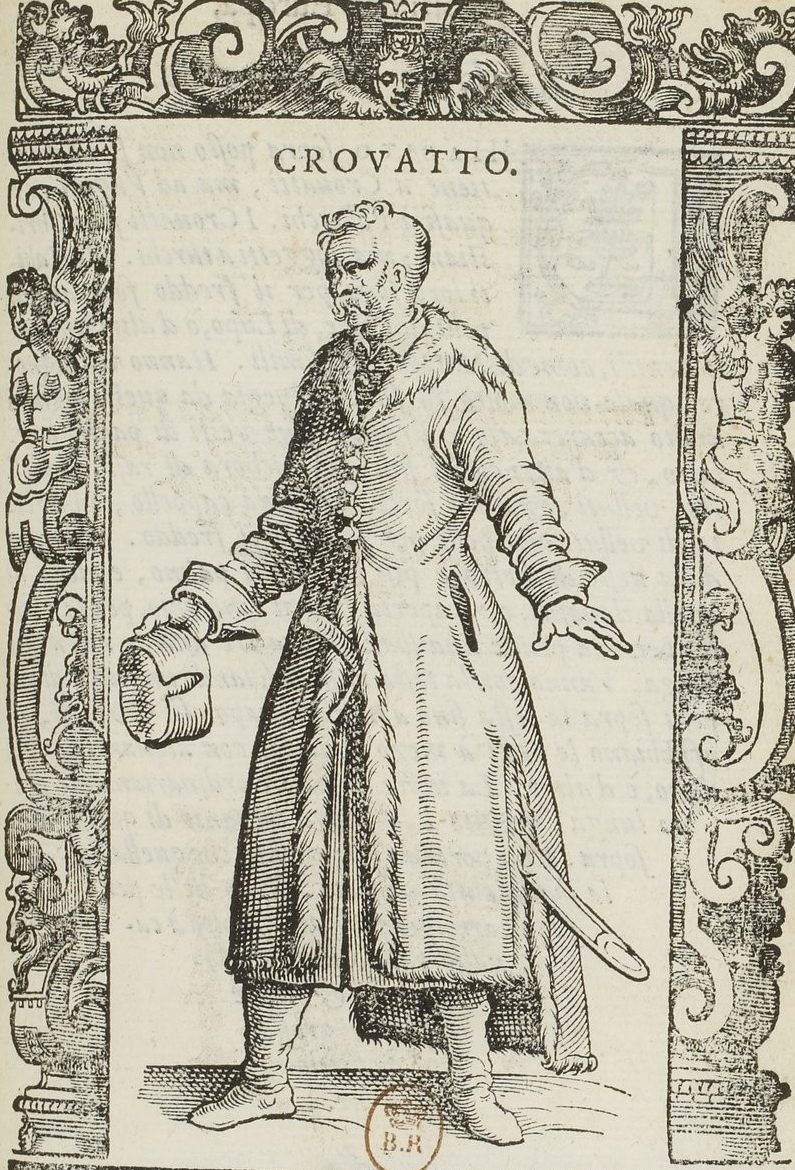
In France, the word cravate would first denote a Croatian soldier and then the neckcloth associated with him. During the second half of the 17th century, that neckcloth would move beyond the military environment and enter court and civilian dress.
Snayers was not painting the history of the cravat. He was painting the military events and people of his own time.
That is precisely what gives his work its particular importance for the history of the cravat. What we see is not a later reconstruction of how Croatian horsemen were believed to have dressed, but a sequence of 17th-century images in which the same detail repeatedly accompanies the same military group.
Before the cravat became court fashion, it appears before us as the neckcloth of the Croatian horseman.
Early Traces
One image may be accidental. Snayers’ sequence is not.
Lützen, the Somme, Pressnitz, Einbeck and Dachau follow Croatian horsemen from 1632 to the final year of the Thirty Years’ War.
On three of those battlefields, their neckcloths are clearly visible.
Only a few decades later, cloth worn in the same place would appear in an entirely different environment – at the courts of Europe.
On Snayers’ battlefields the cravat is not yet a courtly code. It is not yet a symbol of formality. It is not yet the object we recognise today.
It is first and foremost a distinctive element of the Croatian horseman’s appearance.
A detail from which Europe would develop one of its most enduring symbols of dress.
Sources and Literature
• Vladimir Brnardić (ed.), Hrvati – ljudi iza mita. Janko Šajatović Krabat i hrvatske garde u Europi, Ethnographic Museum Zagreb, 2020. See especially the chapter on the Thirty Years’ War and the Croats by Vladimir Brnardić, Filip Hren and Damir Stanić.
• Michael Weise, “Die kaiserlichen Kroaten im Dreißigjährigen Krieg,” in Robert Rebitsch, Lothar Höbelt and Erwin A. Schmidl (eds.), Vor 400 Jahren – Der Dreißigjährige Krieg, Innsbrucker Historische Studien 32, Innsbruck University Press, 2019, pp. 107–115.
• Walter Kalina, “Die Piccolominiserie des Pieter Snayers – Zwölf Schlachtengemälde im Wiener Heeresgeschichtlichen Museum,” in Robert Rebitsch, Lothar Höbelt and Erwin A. Schmidl (eds.), Vor 400 Jahren – Der Dreißigjährige Krieg, Innsbrucker Historische Studien 32, Innsbruck University Press, 2019, pp. 199–222. Earlier published in Viribus Unitis, Jahresbericht des Heeresgeschichtlichen Museums 2005, Vienna, 2006.