Before Louis XIV, French kings were portrayed in ruffs and broad lace collars. With the Sun King, the cravat enters the portrait imagery of the French monarchy. From the early portrait of the young king in 1648 to the courtly representation of 1667 and the portraits of his successors, we can follow the moment when a novelty became part of the visual language of royal authority.
The history of dress rarely offers a single official moment when an object becomes fashion.
There is no decree proclaiming a new silhouette, no royal document ordering Europe to wear a particular piece of cloth from that day forward.
There is something else: the moment when the king begins to wear it.
For the cravat at the French court, that decisive shift is associated with Louis XIV.
Before the Cravat at the French Court
In portraits of Louis XIII, father of Louis XIV, the neck still belongs to an older world of dress. The king is shown with a broad flat or lace collar – a rabat – spreading across the shoulders and resting over armour or clothing. This type of collar defines royal and aristocratic fashion in the first half of the 17th century.
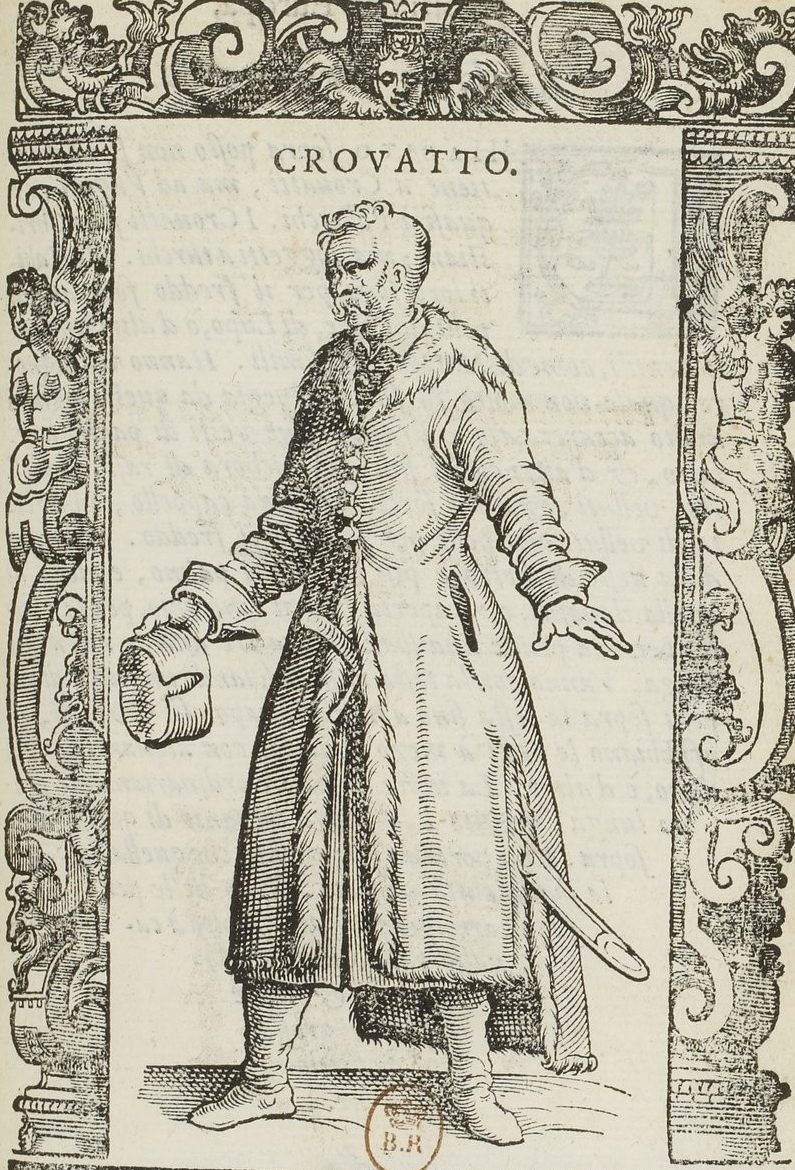
At the same time, neckcloths tied around the neck were already present in Croatian dress, while Croatian horsemen made this way of wearing them highly visible on European battlefields. The soldiers were not the origin of the dress detail itself, but one of the vehicles through which its distinctive form travelled and entered new settings. In France, that dress practice would encounter courtly fashion.

Philippe de Champaigne and studio, Louis XIII, 17th century. The broad lace rabat belongs to the fashion that precedes the cravat at the French court. Public domain / PD-Art.
Louis XIV, c. 1648: The Cravat Becomes Clearly Visible
Around 1648, Henri Testelin portrayed the young Louis XIV in several versions. An especially revealing intimate oval portrait shows the king in armour with a clearly visible red knot at the neck and a lace neckcloth descending beneath it. Unlike the broad collars of the previous generation, the new form around the neck is already visually distinct and immediately legible.
With the young Louis XIV, the new form of neckwear enters the portrait imagery of a French king.
A royal portrait is not a private image. It constructs the public image of power, and clothing that appears within it becomes part of the language of monarchy. What is already clearly visible on the young king around mid-century would become an increasingly prominent element of French court representation over the following decades.

1667: The Cravat Becomes Established at Court
The year 1667 holds a special place in this story.
On 20 May 1667 the reorganisation of a Croatian cavalry unit in French service was completed under the royal title Royal-Cravates. The Croatian name thereby entered the structure of Louis XIV’s army and remained part of French regimental tradition for generations.
At the same historical moment, the cravat was already present on the king himself. This is particularly clear in Henri Testelin’s monumental composition devoted to the foundation of the Académie royale des sciences and the Paris Observatory. Painted later in the second half of the 17th century, the work represents the courtly programme of 1666 and 1667.
The eye naturally moves towards the king. For the history of the cravat it is equally revealing to look at the neckwear of the people in the room: members of the older generation still wear broad traditional lace collars, while Louis XIV and his brother Philippe wear a different form – cloth gathered and shaped around the neck.
The cravat is no longer visible only in an isolated portrait of the young king. It now appears as part of mature courtly representation.
This is why 1667 can be understood as the royal recognition of the cravat: not as a formal decree, but as acceptance at the very summit of the social hierarchy.

Henri Testelin, Establishment of the Royal Academy of Sciences and of the Paris Observatory, probably 1675–1680, Versailles. The composition represents the court of Louis XIV and institutions founded in 1666–1667. Public domain / PD-Art.
The King as a Maker of Fashion
The court of Louis XIV was not merely the political centre of France. It was one of the most influential systems of representation in Europe. From the architecture of Versailles to ceremony, hairstyles, fabrics and tailoring, the way the king presented himself was observed and imitated far beyond France.
Once a neckcloth becomes part of the king’s image, its social position changes. Croatian soldiers were an important medium through which this form of neckwear became visible beyond the Croatian lands. In France, it entered a new social context: alongside its military presence, it became part of courtly fashion and a sign of elegance and representation.
That transformation is one of the decisive moments in the history of the cravat.
Louis XIV: From Novelty to Royal Image
Later images of Louis XIV show how quickly the new form became established. In royal portraits from the second half of the 17th century, the lace cravat grows larger and more decorative. It no longer appears as an unusual accessory searching for its place.
Hair, armour or coat, the ribbons of royal orders and the white cloth descending from the neck together form the recognisable image of the Sun King. By the end of his reign there is no longer any question whether the cravat belongs to royal dress. It already does.
Louis XV: A King Who Grows Up with the Cravat
With his successor, the change is even clearer. Louis XV is not a king who has to adopt a new fashion. He inherits it.
In Hyacinthe Rigaud’s 1721 portrait of the young Louis XV, lace neckwear is already an integral part of the royal image. What had been a novelty under Louis XIV became normal court dress within a single generation.
That may be the clearest sign that a fashion has succeeded: the next generation no longer remembers the world before it.

Hyacinthe Rigaud, Louis XV, 1721. Lace neckwear already belongs to the established language of royal portraiture. Public domain / PD-Art.
Louis XVI: From Fashion to Tradition
By the end of the 18th century the cravat was fully integrated into French male dress. With Louis XVI there is no longer any need to explain how it reached the court or why it belongs there. It simply exists.
Duplessis’s royal portrait of 1777 shows how important the space around the neck remained in courtly representation. And the Musée Carnavalet catalogues an object from the revolutionary period with the wonderfully direct title Buste de Louis XVI avec cravate – Bust of Louis XVI with a cravat.
After more than a century of royal use, the cravat is no longer a novelty. It has become part of the way a king is represented.

Joseph-Siffred Duplessis, Louis XVI, 1777. The royal portrait shows lace neckwear fully integrated into court representation. Public domain / PD-Art.
Three Kings, One Transformation
The portraits of three French kings show more than a change in fashion. They show a change in the status of the cravat.
Louis XIV – the cravat enters the royal image.
Louis XV – the cravat is a courtly norm.
Louis XVI – the cravat is tradition.
The beginning of the sequence is especially striking because it takes place in the same decades in which Croatian soldiers were present in the French army, their name became associated with Royal-Cravates, and the French language adopted cravate for the new neckcloth.
At the French court, the object acquired something that neither a military regiment nor a dictionary could give it on its own: social authority.
Royal Recognition
This is why 1667 is such a compelling historical point from which to speak of the recognition of the cravat.
The cravat existed before that year. The young Louis XIV was already portrayed with its early form in 1648. But in 1667 the story reached another level: the Croatian name gained a lasting place in the royal army through Royal-Cravates, while the cravat became part of the mature representation of Louis XIV and his court.
From that point onward, its European journey increasingly unfolded among kings, aristocrats and courts as well.
The cravat did not need a royal decree.
It was enough for the king to wear it.