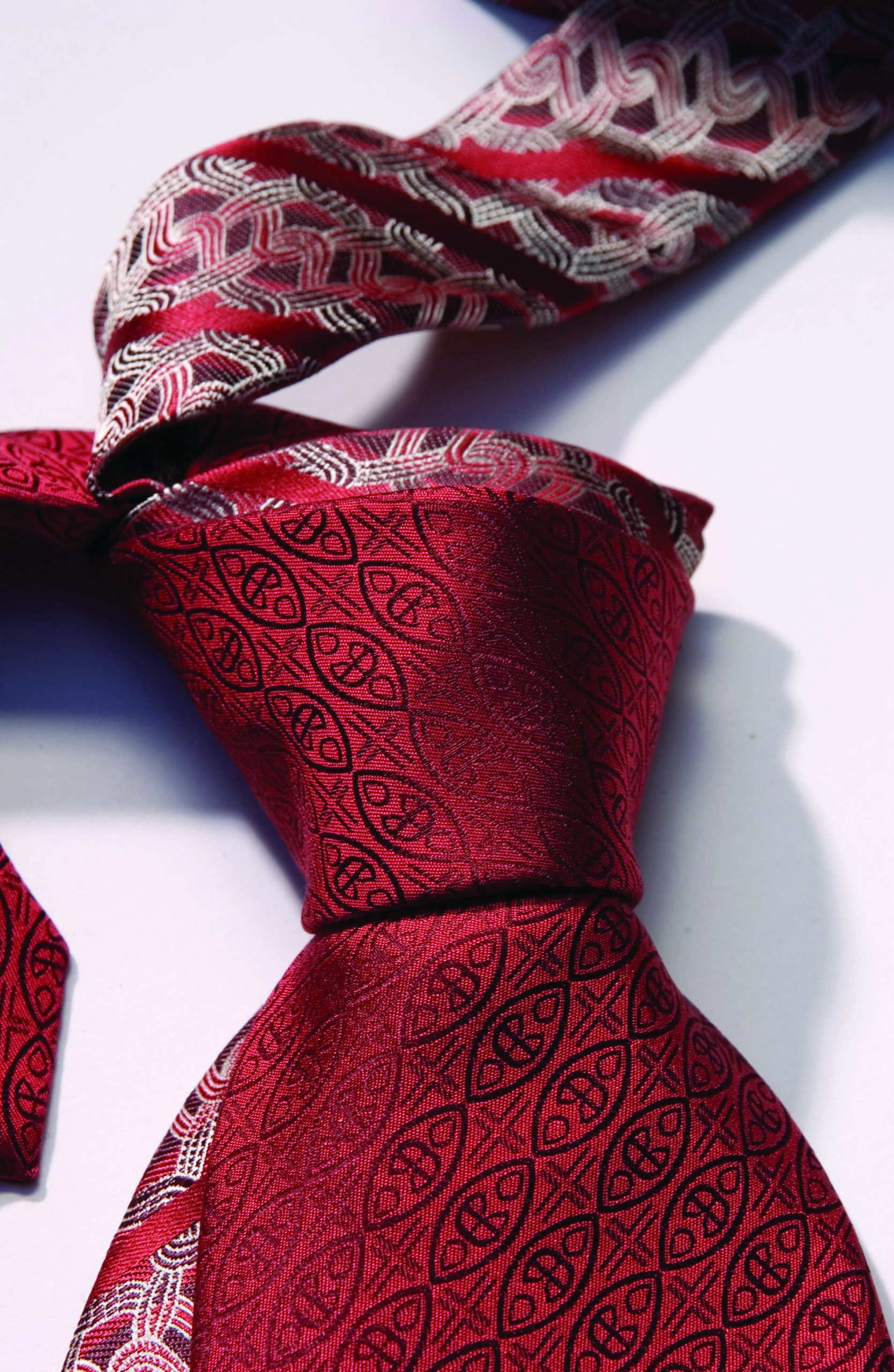
A tribute to the New York innovator who transformed the inner construction of the twentieth century’s most widespread form of cravat.
The history of the cravat is also written in places that remain unseen: in the direction in which the fabric is cut, in the properties of the interlining and in a seam that must provide strength while still allowing freedom.
Among those who understood this quiet dimension of the cravat, Jesse E. Langsdorf holds a special place.
Langsdorf did not invent the cravat, nor did he give it its only modern form. The cravat has never had a single, final appearance. The long necktie, bow tie, ascot, plastron and other forms have changed with time, dress and the occasions on which they were worn.
His contribution concerned the long necktie, the form that would become the most widespread during the twentieth century. Rather than transforming its recognisable exterior, he changed what happened within it.
Looking at the Necktie from Within
We usually look at a necktie from the front. We see its colour, pattern, width and knot. Langsdorf was interested in what remained hidden.
He observed how a tie behaved when it was pulled, tightened and moved beneath a collar. He wanted to understand why some ties became distorted after wear, why their seams were strained and why the fabric ceased to hang naturally.
In a patent application filed on 12 April 1922 and granted on 27 February 1923, he described an improvement to the long, four-in-hand necktie. The outer material, such as silk, was preferably cut on the bias to provide the necessary flexibility. The interlining was intended to give stability without excessive rigidity, while looser stitching along the back allowed the layers to respond to strain.
The essence of his idea was not to make the necktie entirely elastic. It was to allow it to respond to movement and then recover the balance of its own form.
Langsdorf understood that good construction should not struggle against the nature of fabric. It should follow it.
Resilio
His idea did not remain confined to a patent drawing.
Neckties made according to the new principle achieved significant commercial success, and Langsdorf’s business developed under the name Resilio. It was a fitting name for what the product promised: resilience, flexibility and the preservation of form.
A woollen interlining known as Resiline became important to its production. Court records, however, show that Langsdorf’s construction was not simply the result of discovering one unusually suitable material. He learned of Resiline only after filing his patent application, and two of his original ties presented in court had been made with a different woollen interlining of English manufacture.
His innovation therefore lay not only in the choice of fabric. It lay in the relationship between the outer silk, the interlining and the stitching.
The market quickly recognised the difference. Competitors began to imitate the new construction, and the necktie soon travelled from the workshop into the courtroom.
When an Invention Must Be Explained
American courts were asked to decide whether Langsdorf had created a genuine invention or had merely combined methods that were already known.
Silk had been cut on the bias before. Interlinings were already in use, and tailors understood that certain seams required a degree of freedom. Langsdorf did not invent each of these elements separately.
His achievement was understanding how they should work together.
Courts did not always assess his patent in the same way. In 1928, however, the United States Court of Appeals for the Second Circuit concluded that Langsdorf had given the necktie trade something new and immensely useful, which the industry quickly adopted and began to copy.
Two of his original neckties were even submitted as evidence. Silk, interlining and stitches became silent witnesses in a debate about where the experience of a skilled maker ends and invention begins.
This question reveals the wider significance of Langsdorf’s work. Major innovations are not always objects that never existed before. Sometimes an innovation is a new relationship between elements that have long been familiar.
More Than One Form
Langsdorf’s interest did not end with the long necktie.
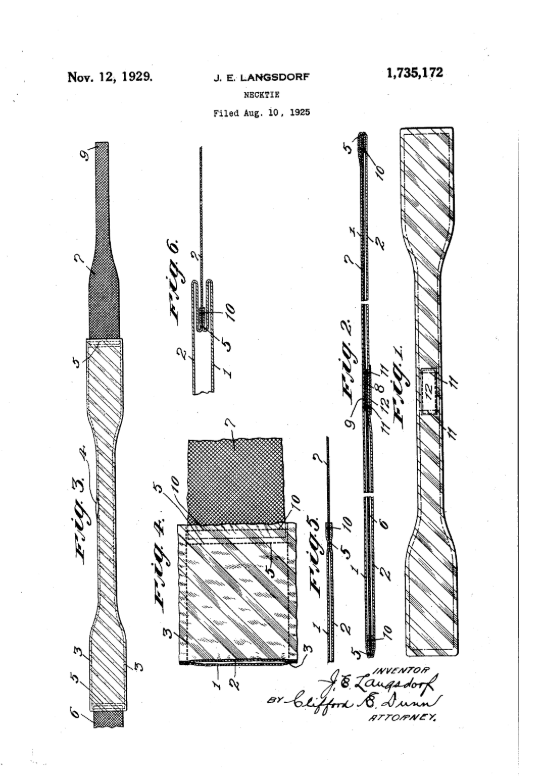
In 1925, he filed another patent application, this time concerning improvements to the bow tie. Granted in 1929, it again addressed similar questions: durability, easier tying and untying, cleaner edges, adjustability and the ability of the material to preserve its form after use.
This gives his work a broader meaning. Langsdorf did not view the cravat as a single, permanently defined object. He understood it as a family of forms, each requiring its own structural balance.
He did not attempt to stop the cravat from changing. He took part in that change.
Elegance That Does Not Announce Itself
Jesse Langsdorf did not change the reasons people wear cravats. He did not define their symbolism or all the ways in which they would later appear in fashion.
His contribution was quieter.
He showed that the quality of an object does not depend only on its visible beauty. It is also shaped by parts the wearer may never see: the direction of the cut, an appropriate interlining and a seam given enough freedom to move.
There is a particular form of respect for the cravat in this approach. It means treating it not merely as a surface for colour and pattern, but as a complete object that must live well with the movement of the person wearing it.
Jesse Langsdorf should therefore not be remembered as the man who gave the cravat its final form. The cravat has never had such a form.
He should be remembered as an innovator who looked inside one of its most widespread expressions — and found room for change there.