German Traces of the Name and the Word Cravat
The German-speaking world occupies an important place in the study of the history of the word cravat. It brings together several distinct but interconnected forms: the modern German word Krawatte, the older and dialectal forms Croat, Krawat, Krabat and Krabate, and historical place names, among which Cravatten Statt, recorded on a map from 1697, is particularly notable.
These forms do not all belong to the same level of meaning. Some refer to the garment, some to Croats as a people or military group, and some to places inhabited by a Croatian population. The German evidence is therefore not merely a linguistic supplement to the French form cravate, but an important part of the broader European history of the word.
Krawatte as the German Name for the Garment
In modern German, Krawatte denotes the tie as an item of dress. Duden explains that the word derives from French cravate, behind which stands the German dialectal form Krawat, meaning Kroate, or Croat. Duden further explains that the original sense was “Croatian neckcloth”, referring to the neckcloth worn by Croatian cavalrymen during the Thirty Years’ War. [2]
Brockhaus offers a similar explanation. In its entry Krawatte, the word is described as a French loanword derived from the German dialectal Krawat, meaning Kroate. Brockhaus states that the garment entered civilian dress through the neckcloths worn by a Croatian regiment in French service around 1670. [3]
The same etymological line is confirmed by Kluge’s Etymologisches Wörterbuch der deutschen Sprache. The entry Krawatte states that the word was borrowed in the seventeenth century from French cravate, while the French form is linked to the German dialectal Krawat, meaning “Croatian neckcloth”, after the distinctive neckwear of Croatian cavalrymen. [7]
Together, these explanations outline an important linguistic path: a name associated with Croats passes into the French form cravate, becomes established there as a term for a neckcloth, and is then standardised in German as Krawatte. [2][3][7]
Croat, Krawat, Krabat and Earlier Forms Referring to Croats
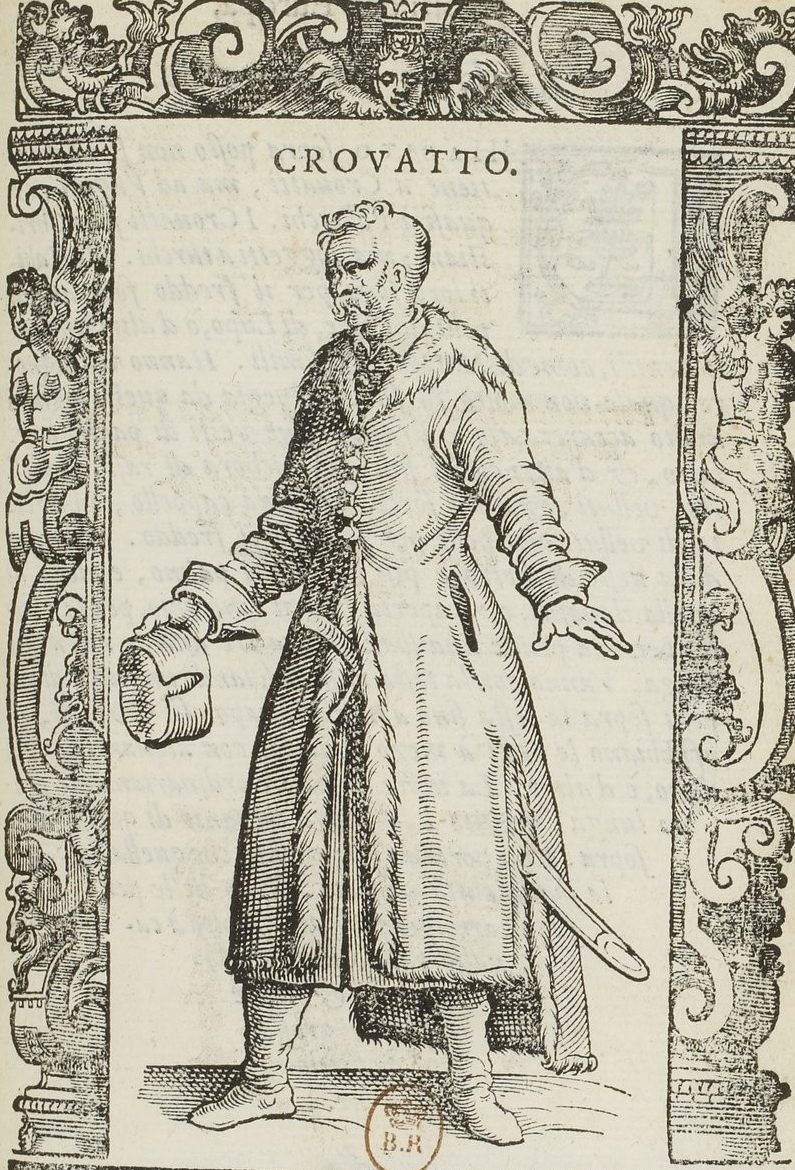
Alongside Krawatte, the older forms Croat, Krawat, Krabat and Krabate are important to the history of the term. In the Grimm brothers’ Deutsches Wörterbuch, the entry Krabate, shortened to Krabat, is linked to the form Kroat; it is said to have entered usage during the Thirty Years’ War and refers the reader to the word Krawatte. Huzjan further notes that Krabat was a German ethnonym for a Croat and that the name was also used in a military context, referring to Croatian cavalry and infantry; the forms Krabat and Krabate spread across several German dialect areas. [1][8]
This is important because it shows that the German forms did not develop solely in a fashion context. Before Krawatte became established as the word for the garment, related forms could denote people, origin, a military group or a type of soldier.
The Digitales Familiennamenwörterbuch Deutschlands, hosted by Namenforschung.net, also links the form Krabat with the name Hrvat. Its entry records the older Sorbian forms Krobota, Krobot, Krabat and Krabate, with explanations including “lively, wild child” and “Kroate”, that is, a designation for a person originating from Croatia. [4]
The Bavarian-Austrian Trace: Krawat and Grawádl
The Bavarian-Austrian linguistic area is particularly noteworthy. Lexicographical material on the Viennese speech tradition notes that Croatian hrvat was borrowed early into Bavarian-Austrian as Krabat and Krawat. Forms such as Grawádl or Grawátl also appear in the same context, meaning a tie or neckcloth. [5]
This evidence shows that forms associated with the Croatian name operated on several levels in the German-speaking world: they could denote a Croat, the adjective “Croatian”, a colloquial or dialectal expression, and the garment itself. It further confirms that the development of the word cravat was not linear, but unfolded across several languages and dialects.
Cravatten Statt: A Historical Place Name on a Map from 1697
One of the most interesting traces in the German-speaking sphere is not a dictionary entry, but a place name. Huzjan notes that Cravatten Statt appears on a geographical map by the Dutch cartographer Sparr de Bensdorf from 1697. The map depicts the area of present-day Slavonski Brod and its surroundings. According to Huzjan, de Bensdorf used the name Cravatten Statt for a fortified settlement on the Slavonian side of the Sava, inhabited by Croats, while he did not assign ethnic designations to the other features on the map. [1]
In this instance, the name does not refer directly to the cravat as a garment. It is more accurate to understand it as “Croatian place” or “town of the Croats”. This interpretation is supported by the broader historical use of forms associated with the ethnonym Croat, including Krabat, Krabate and Krabatten. Cravatten Statt is nevertheless relevant to the etymology of cravat because it confirms that forms such as Cravatten, Krabatten and Krawat could designate Croats in the German and Central European sphere before Krawatte became established as the name of the garment. [1][8]
Academia Cravatica has already devoted a separate article to this subject. It notes that the place name appears on a 1697 map connected with the deployment of Habsburg Monarchy military forces facing the Ottoman Empire and that it refers to the area of present-day Slavonski Brod. [6]
Cravatten Statt therefore forms a valuable bridge between the linguistic and spatial history of the word. It does not prove the existence of the cravat as a garment, but it does confirm the broader use of names associated with Croats in the German-speaking sphere. [1][6]
Caution in Interpreting the Sources
German sources require several distinct levels of meaning to be kept apart. Krawatte is the standard German word for the garment; Croat, Krawat, Krabat and Krabate belong to older ethnonymic and dialectal layers, as well as forms attested in historical sources, all associated with the designation for a Croat; Cravatten Statt is one of the historical place names referring to a territory and its population.
It is therefore insufficient to say that all these words refer to the cravat in its modern sense. More precisely, they belong to the same ethnonymic and linguistic field from which the German word Krawatte developed, but individual forms were used in different contexts: military, ethnic, cartographic, dialectal and sartorial.
Conclusion
German traces of the word cravat reveal a complex relationship among an ethnonym, a military designation, a place name and a garment. Modern Krawatte is linked in dictionaries to French cravate and to the German dialectal Krawat, meaning Croat. The older forms Croat, Krabat and Krabate confirm that the Croatian name was used in the German-speaking world for people, soldiers and groups. The place name Cravatten Statt further shows that related forms also appeared in the cartographic naming of space.
The German evidence therefore cannot be reduced to the word for the garment alone. It shows how one name moved through language, military history, dialects, maps and, ultimately, fashion. This multilayered development makes the German chapter one of the key elements in the European etymology of the cravat.
Sources and Literature
1. Vladimir Huzjan, “Pokušaj otkrivanja nastanka i razvoja kravate kao riječi i odjevnoga predmeta” [“An Attempt to Discover the Origin and Development of the Cravat as a Word and as a Garment”], Povijesni prilozi, 34, Zagreb, 2008, pp. 103–121. https://hrcak.srce.hr/file/43829
2. Duden, entry Krawatte. https://www.duden.de/rechtschreibung/Krawatte
3. Brockhaus, entry Krawatte. https://brockhaus.de/ecs/enzy/article/krawatte
4. Digitales Familiennamenwörterbuch Deutschlands / Namenforschung.net, entry Krabat. https://www.namenforschung.net/id/name/267024/1
5. Wörterbuch der Wiener Mundart, entries related to Krabat/Krawat and Grawádl/Grawátl. https://www.yumpu.com/de/document/view/6937728/worterbuch-der-wiener-mundart-osterreichische-akademie-der-
6. Academia Cravatica, “Cravatten Statt – The Historical Trace of the Croatian Cravat”. https://academia-cravatica.hr/en/cravatten-statt-the-historical-trace-of-the-croatian-cravat/
7. Friedrich Kluge, Etymologisches Wörterbuch der deutschen Sprache, 22nd fully revised edition, edited by Elmar Seebold, Berlin/New York: Walter de Gruyter, 1989, p. 411, entry Krawatte. https://www.dh-lehre.gwi.uni-muenchen.de/wp-content/uploads/2019/08/1565997117_Kluge_Kelle.pdf
8. Jacob Grimm and Wilhelm Grimm, Deutsches Wörterbuch, vol. 5 (K), Leipzig: S. Hirzel, 1873, cols. 1907–1909, entry Krabat, Krabate.