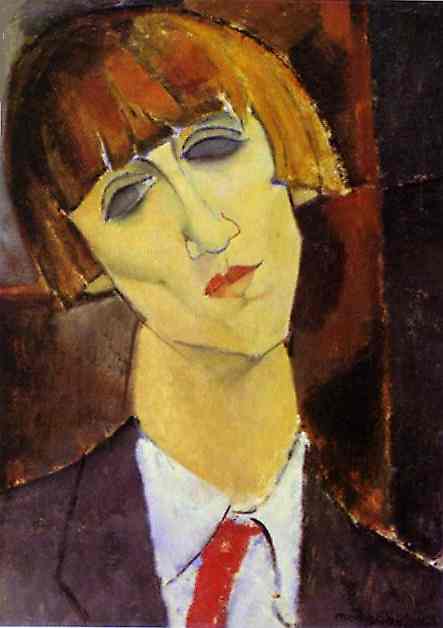
In a portrait from the years of the First World War, Amedeo Modigliani depicted a young woman in a black jacket, white shirt and crimson-red tie. The tie occupies only a small area of the painting, yet it is precisely where colour, clothing and the character of the portrait meet.
Her head tilts to one side.
Dark hair ends close to the face. The black jacket almost merges with the dark area of the background. A white collar emerges from it and, at its centre, sits a narrow red tie.
In Modigliani’s Madame Kisling, painted around 1917, the tie occupies only a small portion of the canvas.
Yet it is difficult not to notice it.
The National Gallery of Art in Washington, where the painting is held today, describes the clothing precisely: a black jacket, a white buttoned shirt and a crimson-red necktie.
In a painting reduced to relatively few large areas of colour, this small piece of red fabric acquires an unusual force.
Madame Kisling who may not yet have been Madame Kisling
The woman in the portrait was Renée Jean Gros, part of the Parisian circle surrounding Modigliani and the painter Moïse Kisling.
In 1917 she became Kisling’s wife.
This introduces a small historical uncertainty.
The painting is known today as Madame Kisling, and the National Gallery of Art dates it to around 1917. Researchers at the Modigliani Initiative, however, have noted that it may have been painted as early as 1916, before the marriage.
If so, the woman we now know as Madame Kisling may not yet have been Madame Kisling when Modigliani painted her.
The distinction is not essential to the painting itself.
But it reminds us of something important about Modigliani’s portrait world: his sitters were not anonymous figures. They were artists, friends, partners and acquaintances from the immediate world of Montparnasse.
The tie therefore does not belong to an invented costume.
It belongs to the way a real young woman chose to appear before the painter.
A woman in a tie
To a contemporary eye, this may be the most immediately striking aspect of the portrait.
The tie has been associated so strongly with masculine formal dress that a woman wearing one can still attract attention.
Yet it would be misleading to present Madame Kisling as the moment when women first “borrowed” the male tie.
Women had worn neckwear and ties long before this portrait. The Metropolitan Museum of Art, for example, holds a French woman’s silk necktie dating from 1870-1880.
The 1917 portrait is therefore interesting not because it depicts something unprecedented.
It is interesting because Modigliani does not treat the tie as an oddity.
He does not explain it.
He does not underline its supposed masculinity.
It is simply part of the person he paints.
The black jacket, white shirt, short hair and red tie together create a highly specific appearance.
The tie is not a disguise.
It is part of the character.
A small vertical
Modigliani is known for elongated necks, narrow faces, almond-shaped eyes and clearly defined forms.
In Madame Kisling, this pictorial language meets the geometry of the tie in a particularly elegant way.
The head is strongly tilted.
The line of the face moves to one side.
The collar is broad and white.
And from its centre the short red tie re-establishes a vertical.
It is a very small gesture, but an important one.
The tie seems to bring the composition back towards an axis after the tilted head and broad dark planes of the shoulders.
At the same time, it connects face and clothing.
Beginning immediately beneath the elongated neck, it guides the eye downward towards the dark jacket.
In another portrait such a detail might disappear.
In Modigliani’s painting it becomes almost a punctuation mark.
Red among reds
The shape of the tie is not the only thing that matters.
So does its colour.
Red appears several times in the portrait.
In the background.
On the lips.
Within the warm tones of hair and complexion.
And in the tie.
But while the other areas of red are broader or softer, the tie concentrates the colour within a narrow, defined shape.
It therefore appears stronger than its size would suggest.
The eye pauses on it.
The white shirt further separates it from the black jacket. A simple contrast emerges: black, white, red.
Almost the entire story of the clothing in this painting can be reduced to those three colours.
And the tie alone carries the strongest of them.
Clothing as part of the portrait
Modigliani famously stylised his sitters.
He elongated necks.
Simplified faces.
Sometimes left eyes almost empty.
He subordinated anatomy to line.
Yet clothing did not therefore become irrelevant.
In his 1918 portrait of Chaim Soutine, for example, the National Gallery of Art can still identify a black coat, dark teal-green waistcoat, white shirt and what may be the black knot of a tie.
In Madame Kisling, the clothing is even more specific.
Her combination is not merely a backdrop to the face.
It participates in how we remember the person.
If the red tie were removed, the face would remain the same.
But the painting would not.
One small detail
The tie in Madame Kisling does not occupy the entire canvas as it does in Domenico Gnoli’s work.
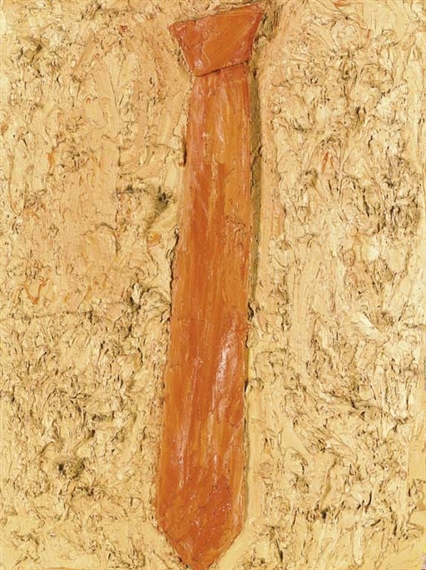
It is not a real object attached to the painting as in Jim Dine.
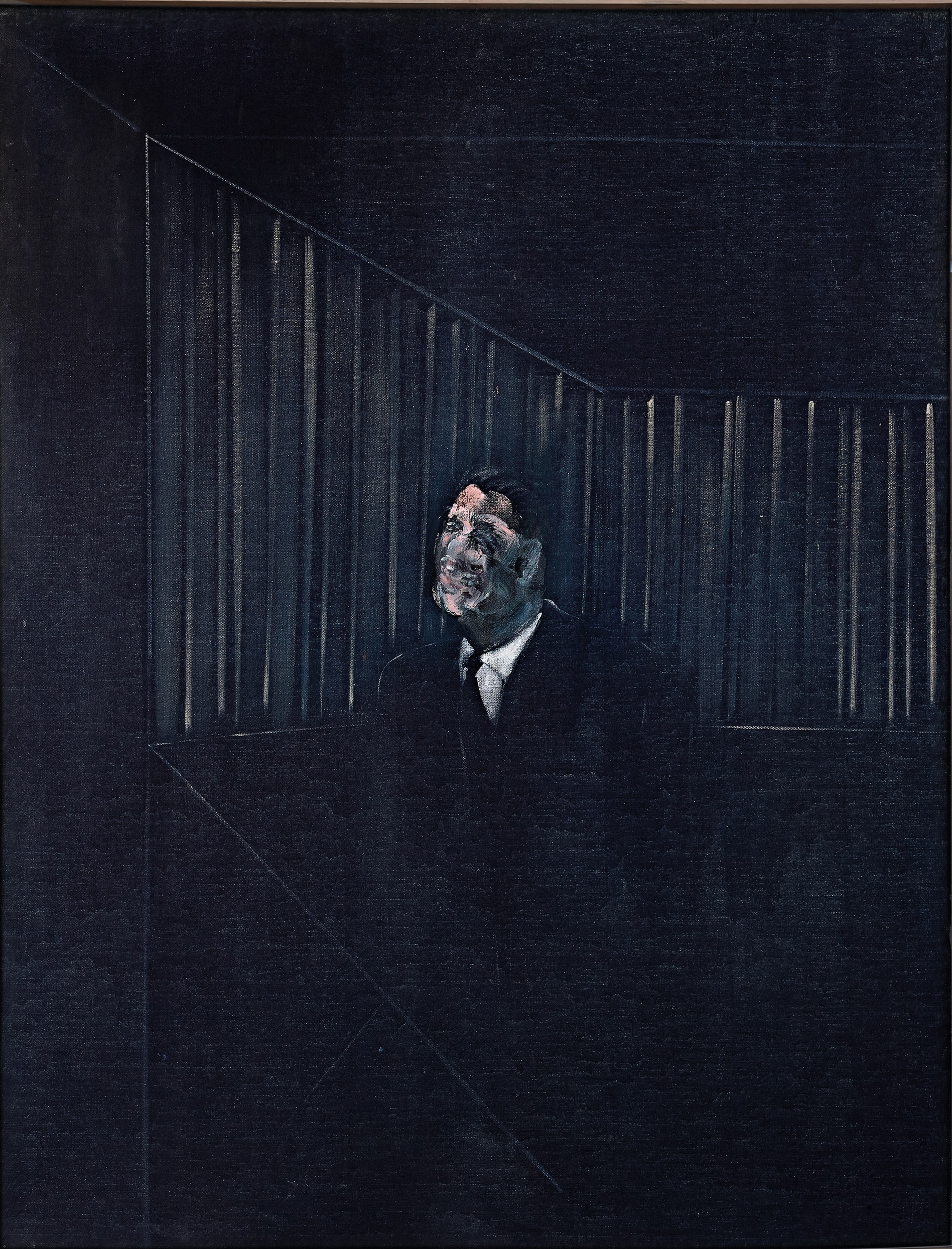
Nor is it part of an unstable figure as in Francis Bacon.
Here, it remains precisely where we expect it.
Around the neck.
Against the shirt.
Beneath the face.
Perhaps this is precisely why the portrait matters within a story of the tie in art.
It shows that an object does not have to become monumental in order to matter.
Sometimes a few centimetres of red are enough.
A small detail that does not take over the portrait.
But changes it.