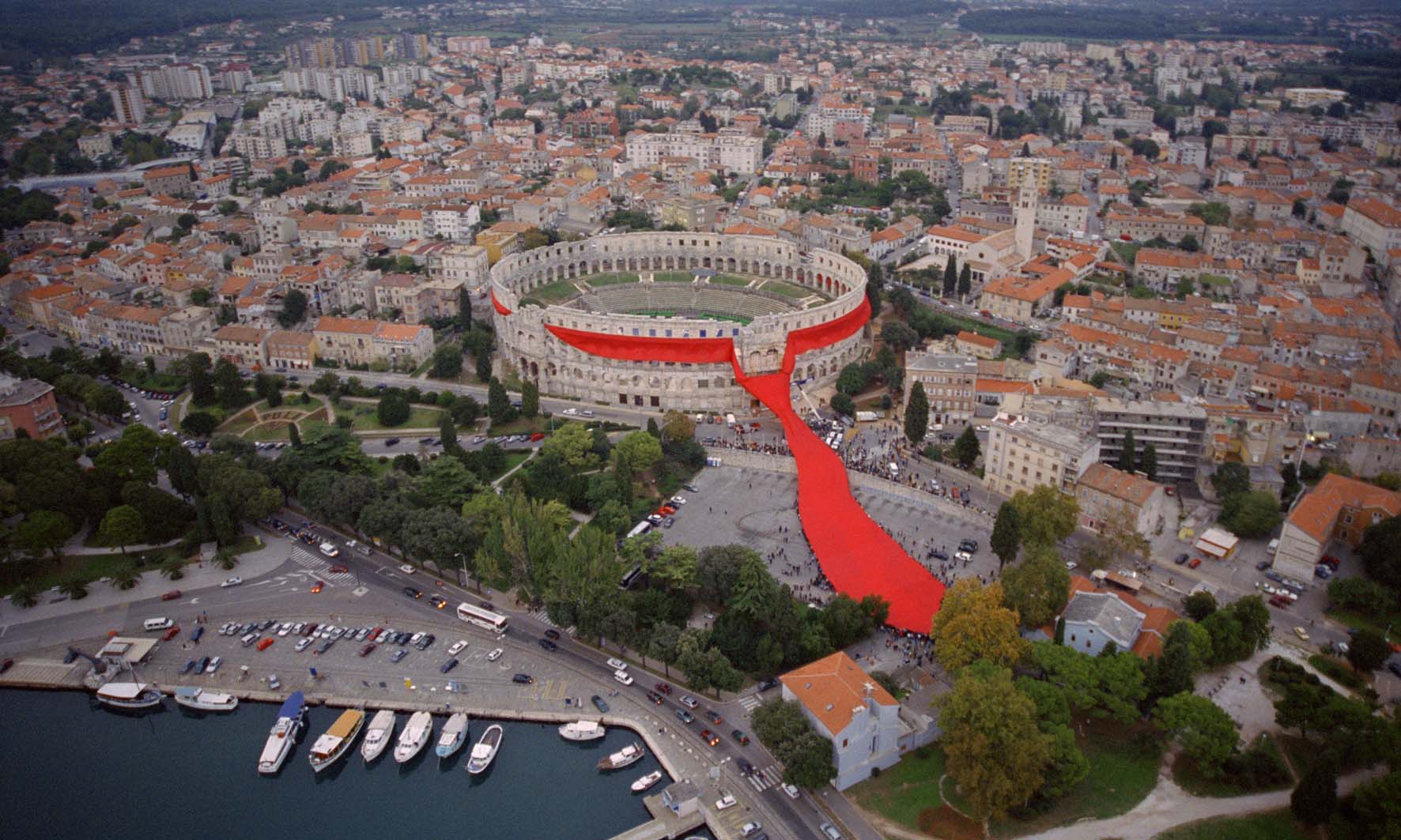
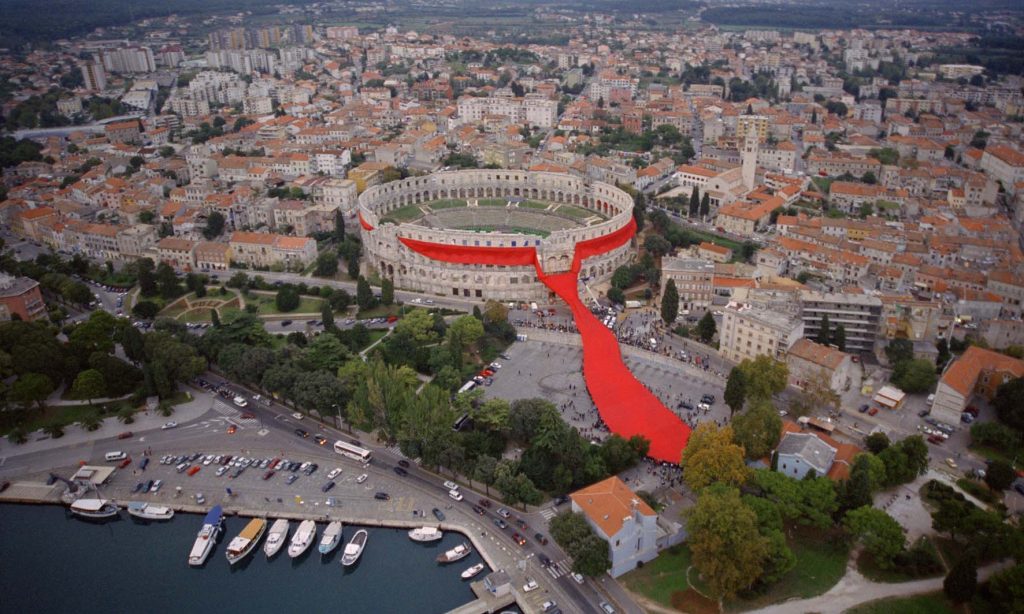
In 2003, a monumental cravat was placed around the Pula Arena. The installation was realised by Academia Cravatica as part of its long-term cultural and research programme dedicated to the history and symbolism of the cravat and its modern descendant, the necktie.
Through this temporary intervention, the Roman amphitheatre from the first century was enveloped by a form that ordinarily belongs to the personal sphere of dress, here elevated to the scale of a public sign.
Monument and Intervention
The Pula Arena is an ancient amphitheatre bearing witness to Roman engineering and the public spectacles once held within its walls. Today it stands as a monument of cultural heritage shaped by layered history.
To intervene in such an environment means consciously entering into dialogue with existing meanings. The 2003 installation did not alter the structure of the Arena nor interfere with its material. The sartorial form was introduced as a reversible and time-bound gesture.
Change of Scale
In everyday life, the modern tie — descended from the seventeenth-century cravat — is a personal object attached to the body of the individual. Transferred to the scale of architecture, it becomes a public sign.
Enlarged to monumental proportions, the form alters perception. It ceases to be a detail and becomes a spatial line articulating the volume and geometry of the amphitheatre.
Permanent and Temporary
The stone of the Arena signifies permanence and stability. The sartorial sign signifies transience and movement. The temporary intervention did not overpower the architecture but established a tension between the enduring and the ephemeral.
After the removal of the form, the Arena remained unchanged. Yet the visual memory of the encounter between two materials and two temporal layers endured as a contemporary cultural act within a historic setting.